
Cloudflare Workers Development
Cloudflare Workers development creates serverless web apps and websites on Cloudflare's global edge network. Scorchsoft builds focused applications with less hosting overhead, connecting storage and databases where needed and checking the fit for your next releases.
UK developers. Deploy to your Cloudflare account or an agreed Scorchsoft environment.
What is Cloudflare Workers development?
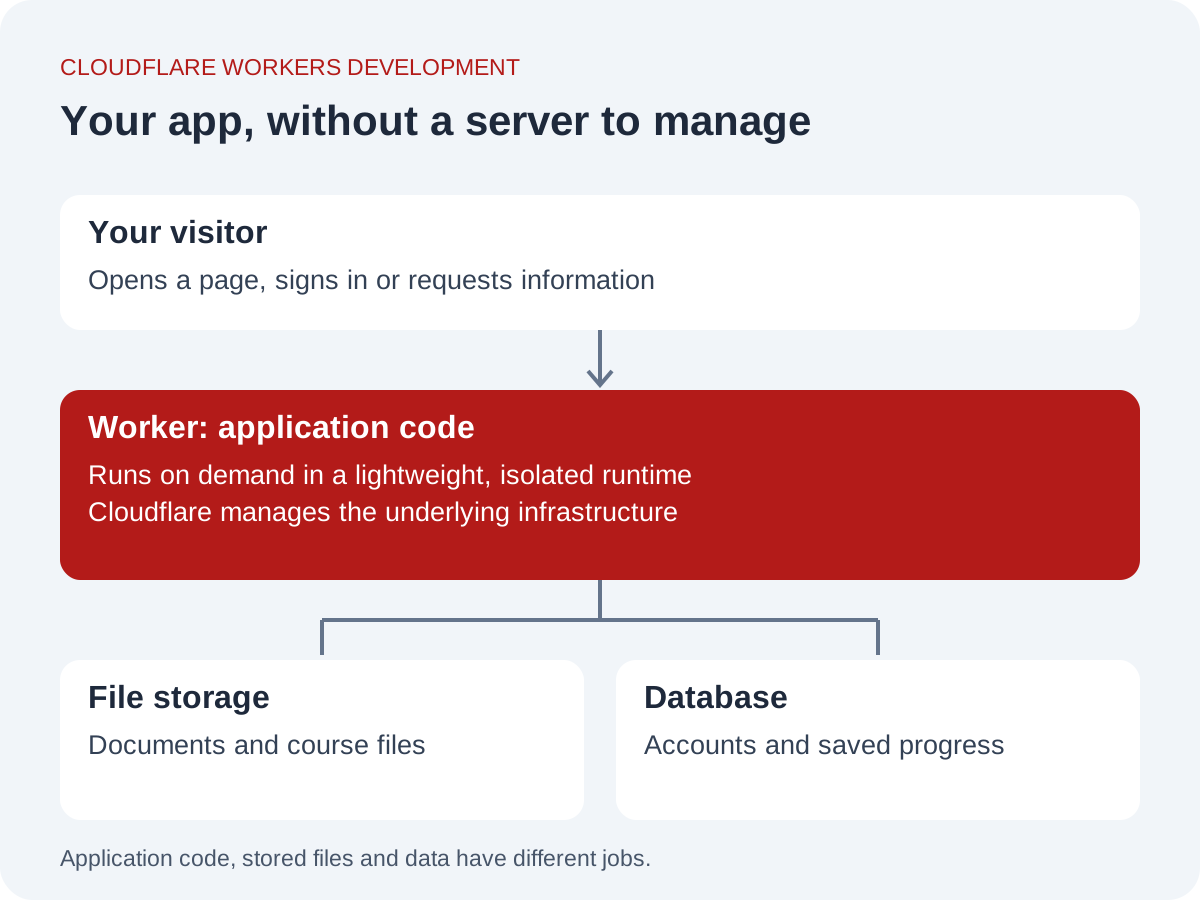
Cloudflare Workers development is the creation of websites, APIs and web applications that run on Cloudflare's managed network. You deploy application code, and Cloudflare runs it when requests arrive. For a suitable project, this removes the need to provision and maintain a dedicated application server.
Think of a Worker as your application's request handler: it receives a request, applies your rules and returns a page or response. Its code runs in a lightweight isolated runtime called an isolate. You are not renting a complete server or deploying a conventional Docker container.
That distinction matters. You cannot assume that software which runs on a Linux server will run unchanged in a Worker. The runtime has supported APIs, language options and resource limits. Files and persistent records normally live in storage services and databases connected to the application.
Cloudflare's explanation of the runtime describes how this differs from traditional hosting. We turn those technical differences into a practical recommendation for your project.
Edge application development: what running at the edge means
Edge computing means processing work closer to the people or systems using it. Cloudflare Workers provides a serverless edge computing platform: application code can run across Cloudflare's distributed network instead of relying on one application server in a single location.
For a website or API, this can shorten the network journey for handling a request. Static content and suitable application logic can be delivered near the visitor. We use edge functions for focused jobs such as request handling, access checks and connecting an interface to other services.
The database still matters. A Worker near a visitor may need to contact a database hosted elsewhere, so “at the edge” does not mean every operation or record is local. We assess the whole request path, including database location, caching and workload placement. Some database-heavy workloads benefit from running the Worker nearer the database.
Our edge application development service starts with that assessment: where does work happen, where does data live, and which arrangement makes the application simpler to run? Cloudflare's placement guidance explains the options.
Keep the running costs proportionate to the application
For smaller projects with a clear scope, we look for an architecture that avoids unnecessary infrastructure and support overhead.
Less server administration
Cloudflare manages the underlying Workers infrastructure, so your project may avoid a separately managed application server and its operating system patching.
A leaner hosting arrangement
A focused application can be cheaper to host and may need a lighter support arrangement than a conventional server deployment. We assess the whole stack before recommending it.
Services with clear jobs
Keep application logic in the Worker, large files in object storage and business records in a database. Add the services the scope requires, with clear ownership.
The AI Stairway: an e-learning web app built on Workers
The AI Stairway is Scorchsoft's online learning platform. Its starting requirements were focused: explain the course, list modules, let people sign in, control access and record learning progress. A dedicated application server would have added infrastructure to a relatively lean product.
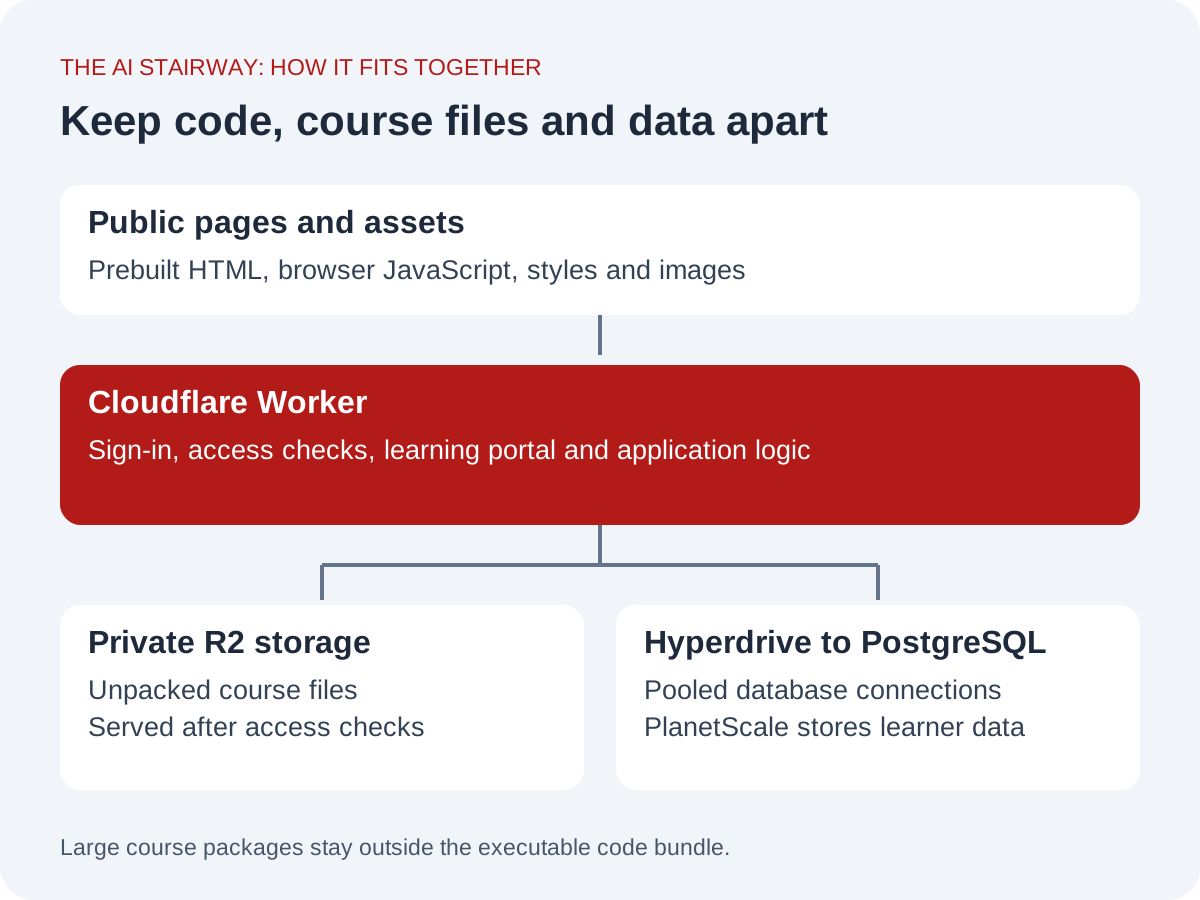
We used Astro deployed to Cloudflare Workers, combining prebuilt public pages with dynamic learner and admin routes. The Worker handles application behaviour; separate services store course files and learner records.
The repository now includes team access, progress tracking and course administration too. This is a working example of a database-driven web app on Workers, rather than a claim that Workers only serve simple pages. Its suitability comes from how the workload fits the runtime.
Why the course files live in R2
Some AI Stairway course packages exceed 100 MB. They belong in file storage, outside the executable Worker bundle. We use Cloudflare R2, an object storage service, for the unpacked learning content.
The upload process extracts a course package and sends its files separately. Course files remain private: the Worker checks the learner's session and access before serving them. This separates publishing course material from deploying application code, while keeping access rules in the app.
Large uploads need their own design. An archive's total size, each file's size and the HTTP request size are different constraints. Depending on the project, we can use separate-file uploads, multipart uploads or direct-to-storage uploads with appropriate authorisation. Adding R2 does not automatically remove every upload limit.
Why we chose PostgreSQL through Hyperdrive
AI Stairway stores accounts, access rights and learning progress in PostgreSQL hosted on PlanetScale. The Worker connects through Cloudflare Hyperdrive, which pools database connections. Hyperdrive is the connection service; PlanetScale hosts the database.
Cloudflare also offers D1, a managed SQL database built on SQLite. It can suit lean applications, and AI Stairway originally used it. Each D1 database processes queries one at a time; its throughput depends on query duration and request patterns. PostgreSQL supports concurrent transactions and row-level locking, which gives us more flexibility as several learners and administrators update different records.
For this project, we chose PostgreSQL for that concurrency model and the wider database options it gives us. It adds another service to configure, secure, back up and monitor. D1 remains a sensible option where its operating model fits.
See Cloudflare's D1 concurrency guidance, how Hyperdrive works and PostgreSQL's locking documentation.
Cloudflare Workers for static websites
Workers Static Assets can serve prebuilt HTML, stylesheets, browser JavaScript and images. This is useful for brochure sites, author websites and focused marketing sites where visitors mostly read content. A Worker can add selected dynamic behaviour, such as processing an enquiry.
Epitomise and AndrewLeeWard.com are examples of our choice to use this approach for content-led websites. We opted to keep their content in the site code rather than add a content management system (CMS). That kept the architecture simpler for how those sites would be maintained.
A CMS is still possible. If your team needs to edit pages independently, we can assess a suitable CMS or build a database-driven admin interface. That introduces permissions, publishing workflows and maintenance work, so it should follow a real need. A static website and an editable business application do not have to share the same architecture.
When do we recommend Cloudflare Workers?
We check the workload and roadmap, not just the number of users. Workers can serve high traffic; complex dependencies or unsuitable processing can be the stronger reason to choose another platform.
Often a good fit
- A focused web app, customer tool, learning portal or API with a clear first release.
- A static or mostly static website with a small number of dynamic features.
- Compatible libraries and request-driven application logic.
- Files and records that can live in appropriate storage and database services.
- A roadmap that stays within a manageable set of features and dependencies.
Investigate another architecture
- Existing software that depends on a full server environment or unsupported native packages.
- Heavy media processing, large in-memory calculations or work that exceeds execution limits.
- A large dependency footprint with little room for future features.
- Requirements that need arbitrary system software or extensive operating system access.
- A roadmap likely to force repeated workarounds or a costly platform migration.
We can assess conventional cloud hosting or a hybrid application where Workers handle only the parts that fit.
The limits we check before committing to Workers
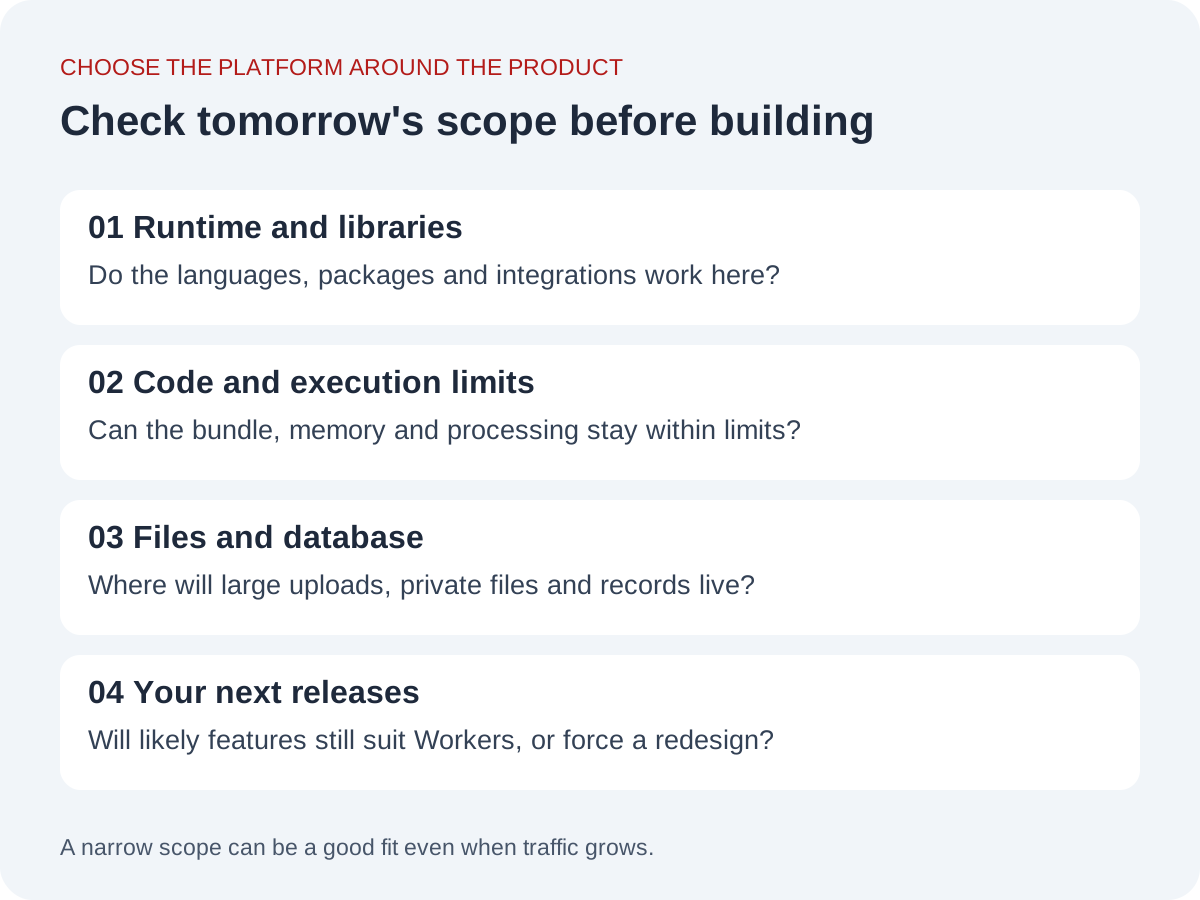
Every hosting platform has constraints. With Workers, we check the deployable code size, runtime memory, processing time, library compatibility and database workload before choosing it.
As checked in October 2026, Cloudflare lists a 64 MiB uncompressed Worker bundle limit. Static Assets have separate limits: 25 MiB per file and 100,000 files per Worker version on the paid plan. Static assets are stored separately from the executable code bundle. These limits can change, so we verify them for the proposed deployment.
Adding libraries consumes bundle space and can introduce assumptions about the runtime. Moving large course files to R2 solves a storage concern; it does not make incompatible application code work.
We also review likely future features. If success would mean adding software that cannot run here, another starting point may cost less over the life of the project. High traffic alone does not mean you must leave Workers.
JavaScript, TypeScript and the wider technology choice
JavaScript and TypeScript are common choices for Workers, and AI Stairway uses this ecosystem. Many familiar web libraries work well, but a package's compatibility must be checked rather than assumed.
Workers are not restricted exclusively to JavaScript. Cloudflare also supports Python and WebAssembly-based language options. Those routes have their own runtime and package constraints; they do not provide the freedom to install any language runtime, native library or command-line tool as you would on a general-purpose server.
If you already depend on substantial PHP, Python, Java or other server-side code, we examine what can run directly, what could stay behind an API and what would need rewriting. Preserving proven code may be more valuable than moving every component onto Workers.
Cloudflare's supported languages provide the starting point for that compatibility review.
How we develop and deploy your Worker application
From architecture choice to handover
We can build in your own Cloudflare account or deploy to an agreed Scorchsoft environment. We agree ownership, access and ongoing responsibilities before launch.
Check the scope and roadmap
Review the users, workflows, integrations, file sizes and likely next releases. Compare Workers with other hosting options before committing.
Design the complete application
Choose static and dynamic routes, authentication, storage and a database. Include access control, backups and recovery in the design.
Build and test representative workloads
Develop the interface and application logic, then test uploads, simultaneous updates and dependency compatibility against the expected use.
Configure and deploy
Set up the Worker, domains, service bindings, secrets and deployment process in the agreed account. Keep development and production resources appropriately separated.
Hand over and support
Document the setup and agree monitoring, dependency updates, backups and incident support. Match the service arrangement to the application's actual needs.
Lower infrastructure overhead, with clear support responsibilities
For a smaller, narrowly scoped project, Workers can avoid the need for an extensive server support and maintenance arrangement. We want the service model to fit what your application actually needs, so we consider this option where it removes complexity and ongoing overhead.
The app still needs care. Application bugs, dependency updates, account access, database backups and connected services remain somebody's responsibility. We agree those responsibilities explicitly and assess the combined running costs of the Worker, file storage, database and integrations.
If you want direct ownership of the hosting account, we can configure the application in your Cloudflare account and document its deployment. If you prefer Scorchsoft to manage the environment, we can agree an appropriate arrangement. The right option depends on your team's capacity and the support you need.
Explore our supported technologies or contact Scorchsoft to discuss the scope.
What Our Clients Say
Scorchsoft helped us take our idea for an app and make it a reality. Everything from the planning meeting to decide what we really needed to the project management and execution was great. It was delivered on time - early in fact - and on budget. Highly recommend.
 Rebecca PalserDragonfly Intelligence
Scorchsoft is a brilliant company with fantastic knowledge of the mobile app industry. From the project management to the development team, they have been the perfect candidate for our project, and we can't thank them enough!
 Lance ChorltonGapped Online
We're really pleased with the work Scorchsoft has done in developing our web portal! They have been accurate with timelines and budget, delivering a solid product that allows us to monitor and manage patients remotely while they use our novel medical device at-home. The "plan - design - build" approach has worked well and saved us time in the long-run by catching requirements and issues early.
 Daniel GreenSensTrain
I'm really pleased with how my app came out, it was exactly what I was looking for. The team at Scorchsoft are great at what they do and made the whole process as simple and easy as possible. Being someone who is not very tech savvy the set up and back end operations were done in a great easy to use manner even for myself which makes using my app stress free. Thanks to all the team!
 Ruben CarrollMosaic Masterpieces
The new Flourish Education website has already removed a lot of manual processes, freeing up both schools, candidates and internal employees time. We are delighted with the look and feel which is clean, professional and more engaging. We are also pleased with the decision to have an HD video background on the homepage, and building immediate trust with our clients by giving them a taste of what it looks like in the Flourish Education offices.
James HancocksMarketing Manager, Flourish Education I can't believe how quickly we started to see results with this project. Scorchsoft provided us with graphic-designed mockups of how the app would look once built, and we were able to sell the product for use by our first customer before the product was finished. Since launching in March, we have secured a major television network as a client who now uses Image Approvals to manage the talent approval process for their productions.
Aimee SpinksMD, ImageApprovals.com
Could your project work with less hosting overhead?
Tell us what the application needs to do, which services it must connect to and what you expect to add later. We can discuss whether Workers is a sensible option before detailed planning.
A focused first release deserves a proportionate infrastructure and support plan.
Cloudflare Workers developers in the UK
Choose around the application you need
Scorchsoft develops web apps, portals and integrations from Birmingham. We use Workers where they simplify delivery and running the product, and recommend other infrastructure when the workload calls for it.
Questions
Yes. Workers can handle application routes, sign-in, permissions and APIs while connected databases and storage services hold persistent data and files. AI Stairway combines these components for an e-learning portal. Suitability depends on the workload and supported dependencies.
Yes. Workers is a serverless edge computing platform that can run application code across Cloudflare's distributed network. By default, request handlers run near where requests arrive. Database and API calls may still travel elsewhere, and workload placement can be adjusted where running nearer those services improves overall response time.
No. Workers can handle substantial traffic. A lean scope can make development and support simpler, but traffic volume is a separate consideration. We assess database throughput, processing time, memory and connected services as part of the whole application.
Yes, with an appropriate storage and upload design. R2 can hold files separately from Static Assets, but request limits and application limits still matter. We may split uploads or use multipart or direct-to-storage transfers. AI Stairway unpacks course archives and uploads their files separately.
D1 is a Cloudflare-managed database based on SQLite. Each database processes queries serially. PostgreSQL supports concurrent transactions and row-level locking, with a separate hosting service. We use PlanetScale PostgreSQL through Hyperdrive for AI Stairway and choose around each project's data and concurrency requirements.
Need help building your ideas?
Tell us where you're headed and we'll come back with our thoughts, a realistic plan and a rough cost estimate. Scorchsoft is a UK-based team of app, portal and AI developers, working in-house from Birmingham's Jewellery Quarter.