
How to scope and build an MVP without building the wrong thing
For founders and product owners about to commission a first build: how to pick the one thing your MVP has to prove, how to cut scope without gutting the product, and how to know whether it worked.
- Author
- Andrew Ward
- Managing Director
- Last reviewed
- Reading time
- 8 min

In this guide
In summary
A minimum viable product is the smallest version of a product that can test whether the idea works, with real users doing real work. The hard part is not building it — it is deciding what to leave out. This guide covers how to find the assumption your MVP has to test, a scoping method that cuts features without making the product pointless, what an MVP costs and how long it takes, and how to set success criteria before you write a line of code.
Key takeaways
- An MVP tests one assumption. If you cannot say which assumption in a sentence, you are building a small product rather than an experiment.
- Cut scope by narrowing the user and the journey, not by half-building features. One user type doing one job end to end beats five types doing nothing properly.
- Write the success criteria before the build. An MVP with no pass mark always looks like it needs a few more features.
- In our projects most MVPs launch within 2 to 8 weeks, typically across 2 to 4 fixed two-week sprints, committed one at a time.
- The most expensive MVP is the one that launches to nobody. Line up the first ten users before you commission the build, not after.
What an MVP actually is
A minimum viable product is the smallest version of a product that can test whether the idea works, with real users doing real work. Two words in that sentence do the heavy lifting. Minimum means it is as small as it can be and still answer the question. Viable means someone can genuinely use it to get something done — not a demo, not a mock-up, a working thing.
The term comes from lean startup practice, where Eric Ries defined it as the version that lets a team collect the maximum validated learning with the least effort. The emphasis on learning is the part most often lost. An MVP is an experiment that happens to be shipped software. If you are not going to change your plans based on what it tells you, you are not building an MVP, you are building version one on a tight budget — which is a legitimate thing to do, but it needs a different conversation about scope.
The UK government's own service standard uses the same logic under different names, moving a service through discovery, alpha and beta before committing to live. Each phase exists to kill bad ideas cheaply.
The wrong thing people usually build
The characteristic failure is not building too little. It is building a complete, small product that answers no particular question.
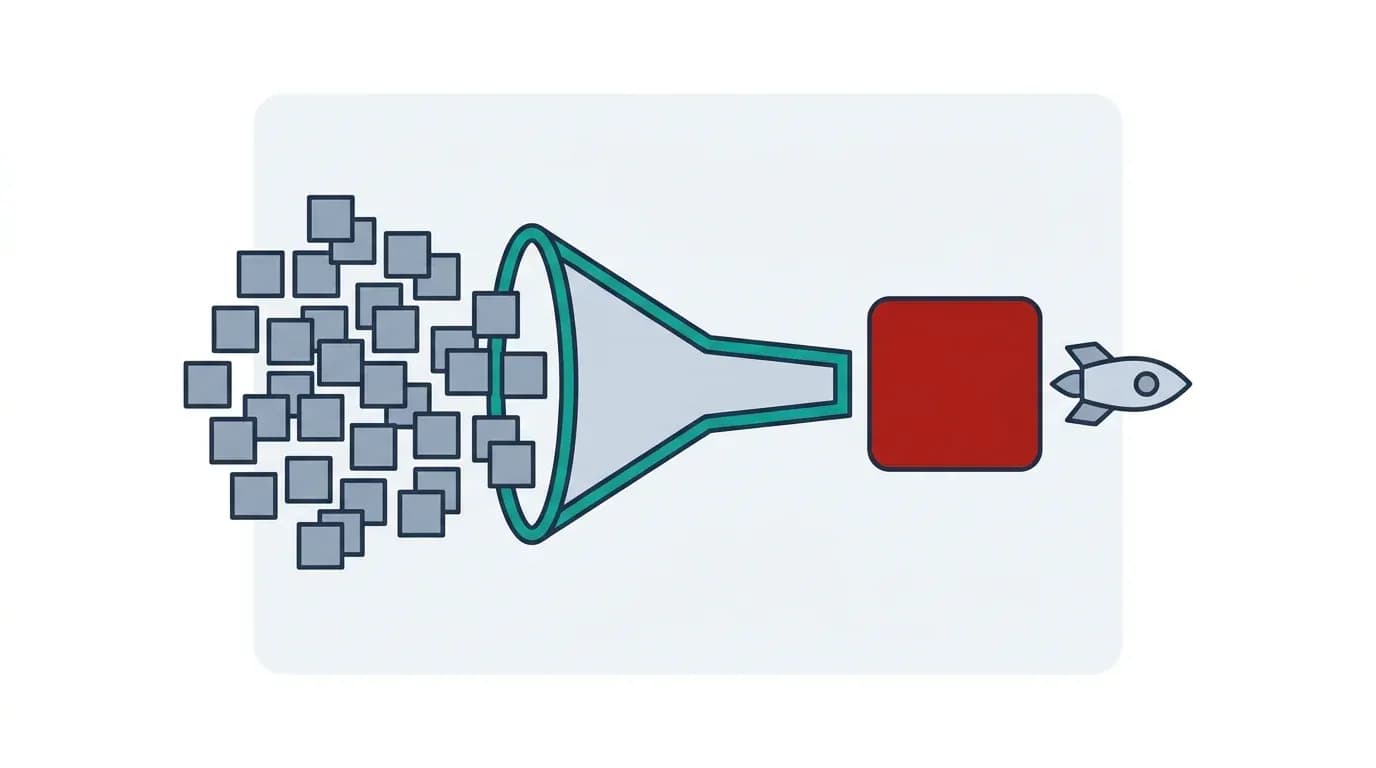
It looks like this: the team lists everything the product should eventually do, cuts the list roughly in half, and builds that. The result has a bit of everything — user accounts, a settings page, an admin area, three of the eight core features — and none of it is complete enough for anyone to actually run their work through. Users try it, get to the point where the thing they needed is missing, and leave. The team learns that people "weren't ready for it", which is not information you can act on.
Halving a feature list feels like prudent scoping, and it is the most reliable way we know of to waste a first budget. The alternative is to narrow rather than halve, which is what the next two sections cover.
Start from the riskiest assumption
Before scoping anything, write down the assumption that, if wrong, makes the whole idea pointless. Not the biggest technical unknown — the biggest commercial one.
For most products it is one of a small set. Will anyone change their current behaviour to use this? Will they pay? Can we reach them affordably? Does the work actually get done faster this way? Is the data good enough to make this useful?
Then ask what the smallest thing is that would test it. Frequently that is not software at all: if the assumption is "people will pay for this", a landing page and a deposit tests it faster than a build. If the assumption is "this can be made to work technically", you want a proof of concept, not an MVP. Reserve the MVP for the assumption that genuinely needs real users doing real work to settle.
Naming the assumption also gives you a way to end arguments about scope. Every proposed feature gets one question: does this help us test the assumption? If not, it goes on the list for later, without anyone having to claim it is unimportant.
Cut scope by narrowing, not halving
The method that works is to narrow three dimensions and keep the fourth complete.
- One user type. Pick the single audience whose problem is sharpest. Not "businesses and consumers" — one.
- One job. The single task they will use it for, not the four adjacent ones.
- One path. The happy path through that job. Edge cases, bulk actions, imports and integrations wait.
- But complete. That one path works end to end, properly, for a real user with real data.
This is the opposite of the half-a-feature-list approach, and it produces something people can genuinely use. It also gives you clean evidence: if the one user type doing the one job does not come back, you have learned something real rather than something confounded by a half-finished product.
The second lever is deciding what to fake. An MVP does not need everything automated. Manual onboarding, a human reading submissions, a report assembled by hand, a spreadsheet behind the scenes — all fine, as long as the user's experience is real. Faking the back end is cheap and reversible; faking the user's experience is what makes an MVP useless.
MVP vs prototype vs proof of concept
These get used interchangeably and they answer different questions, which is why the confusion is expensive.
- A proof of concept answers "can this be built at all?" There are no real users, and the software only partly works — enough to prove the mechanism and no more.
- A clickable prototype answers "do people understand it, and is this the right shape?" Real users test it, but nothing works underneath: the screens look real and do nothing.
- An MVP answers "will people use it, and does it deliver value?" Real users in the wild, with genuinely working software behind the screens.
The sequence matters commercially. A clickable prototype is dramatically cheaper than an MVP and catches most design and comprehension problems, and in our projects the full prototype process completes in approximately 3 to 4 weeks. Skipping it to "save time" usually means discovering the same problems in built software, where changing them costs many times more.
Set the success criteria before you build
Write down, before the build starts, what result would make you continue, change direction, or stop. Be specific about the number and the window: how many users, doing what, how often, by when.
This is the single most skipped step, and skipping it has a predictable consequence. Without a pass mark, every MVP result looks ambiguous, and the default interpretation is always "it needs a few more features". That is how a four-week experiment becomes an eighteen-month build with no decision point.
Pick measures of behaviour rather than opinion. People telling you they like it is not evidence; people using it twice in a week without being chased is. Gov.uk's user research guidance is a good, free grounding in watching what users do rather than asking what they think.
Agree in advance who makes the call, too. A criterion nobody owns is a criterion that gets renegotiated the day the data arrives.
What an MVP costs and how long it takes
In our projects, MVPs are built in fixed two-week Velocity Sprints, and most aim to launch a functional, usable MVP within 2 to 8 weeks — typically spanning 2 to 4 sprints. Most clients start with 2 to 4 sprints, you commit one sprint at a time, and you can stop at the end of any current sprint rather than signing up for the whole programme.
Each sprint is a fixed price with a predictable number of Output Units, which are units of finished work rather than time spent. That structure exists to answer the question this guide keeps returning to: it lets you stop when you have learned enough, instead of when the budget runs out.
On the total, our quote page publishes a floor rather than a price list — apps and portals take hundreds of hours, so a bespoke project under £7.5k is unlikely and most of our projects are more than that. Payment tracks delivery; the worked example there is a £20,000 project over three months, split into a deposit plus one payment at each month end.
If you want the scope and estimate settled before committing to a build at all, Quickstart App Planning typically completes within 3 to 6 weeks.
The mistakes we see most
Five recur across the MVP projects we take on, and none of them are technical:
- No first users lined up. The build finishes and there is nobody to give it to. Recruit the first ten before commissioning anything; if you cannot find ten people who want it, that is the finding.
- Admin before product. Weeks spent on user management, permissions and settings screens before the thing that delivers value exists. Do the value first, even if you administer it by hand.
- Scope creep dressed as feedback. Early users will ask for things. Log them; do not build them until the original assumption is settled.
- Building for the pitch, not the user. An MVP shaped to impress investors optimises for a demo and teaches you nothing about usage.
- No decision meeting. The criteria were written, the data arrived, and nobody ever sat down to decide. Book that meeting when you start the build.
After the MVP
There are only three honest outcomes, and all three are successes in the sense that matters: you now know something you did not.
If it worked, the next question is what to harden rather than what to add. The shortcuts you took deliberately — the manual onboarding, the missing edge cases, the spreadsheet in the middle — now need paying off before load makes them expensive, and that is the point at which technical debt stops being a sensible trade and starts being a risk.
If it half-worked, the useful move is to narrow further rather than broaden: find which slice of users got real value and serve them properly before widening.
If it did not work, stop. That is the outcome the whole approach is designed to make cheap, and a four-week answer is a good result. The expensive version of that answer takes two years.
If you would like help deciding what your MVP has to prove and what the smallest version looks like, see how our sprints work or ask for a quote against your own scope.
Frequently asked questions
The smallest version of a product that can test whether the idea works, with real users doing real work. Minimum means as small as possible while still answering the question; viable means someone can genuinely use it to get something done, rather than look at a demo.
In our projects most aim to launch within 2 to 8 weeks, typically across 2 to 4 fixed two-week sprints. Longer than that and the scope has usually stopped being minimum. You commit one sprint at a time, so the timeline can end as soon as you have learned enough.
A prototype is screens that look real but do nothing, used to test whether people understand the idea. An MVP is working software real users can do real work in. A prototype is far cheaper, so it is worth doing first — it catches comprehension problems before they are built into code.
Wrong question. Narrow the user type, the job and the path to one each, then build that one path completely. Counting features encourages halving a wishlist, which produces a product with a bit of everything and nothing anyone can actually use end to end.
Then it did its job cheaply. The point of keeping it small is to make a negative answer affordable, and a four-week no is a far better outcome than a two-year one. Decide before you build what result would make you stop, and book the meeting where that call gets made.
Terms used in this guide
Key topics covered
- What an MVP is and is not
- Finding the riskiest assumption
- Scoping by narrowing, not halving
- MVP vs prototype vs proof of concept
- Setting success criteria
- Cost and timeline
- Choosing what to fake
- What happens after launch
- Common MVP mistakes
Sources referenced
Build your MVP in two-week sprints
Fixed-price sprints, a usable release in weeks rather than months, and the option to stop at the end of any sprint.

About the author
Andrew Ward
Managing Director
Andrew Ward is the founder and Managing Director of Scorchsoft and author of The Control Standard, Execute Your Tech Idea and The ChatGPT Guide for Business. With more than sixteen years of experience building software and running a business, he writes about practical ways to apply technology, use AI and lead teams that deliver.
Andrew holds a first-class degree in Computer Science with Business Management from the University of Birmingham and has represented Great Britain in bench press, winning world championship bronze in 2023.
Want to talk about your project?
Tell us what you’re trying to achieve and we’ll map the fastest credible path.