
Membership Organisation App & AI Development
We build member portals, accreditation and audit apps, and AI tools for professional bodies, trade associations and membership organisations — software that gives members, assessors, branches and staff each the right view of the same data.

Building for teams across healthcare, logistics, motorsport and manufacturing
Trusted by 220+ organisations







One record, five audiences
A membership organisation is rarely one system's worth of work. The same underlying record — a member, a training centre, an accredited individual — has to look different depending on who is reading it. A member sees their own profile, renewal date and training history. A prospective member sees the marketing site and a paywall. An assessor sees a candidate's assessment history and nothing at all about their subscription. A branch or regional officer sees their own patch. Staff see everything, and are usually the people holding the whole thing together by hand.
Most of the operational pain in this sector comes from that fan-out being managed manually. In practice it looks like:
- A membership database that is really a spreadsheet, alongside a separate CRM and a mailing list nobody is confident is current.
- Accreditation or audit records captured on paper in the field and typed up days later, so the register is never quite right.
- Members-only resources protected by little more than an obscure URL, or by a plugin bolted onto a marketing website.
- Renewals chased by hand, with payments reconciled against the membership record by a person with a two-screen setup and a lot of patience.
- Board and committee reporting assembled from exports in the week before the meeting.
None of this is urgent until it is. It becomes urgent when the organisation grows past the point where one person can hold the exceptions in their head, when an accreditation scheme has to stand up to outside scrutiny, or when someone asks a question the data cannot currently answer.
Role-based access is the backbone, not a feature
Almost every requirement on a membership project resolves back to one question: who is allowed to see and do what. Get that model right early and the rest of the build is ordinary software. Get it wrong and every new audience — a new grade of membership, a regional committee, an external verifier — becomes a fresh round of workarounds.
That is why we treat permissions as the first design decision rather than a late one, and why it is worth reading how we approach portal development and single sign-on before settling on a structure. It is also the reason a membership system is usually a portal rather than a website with a login on it: the data model has to carry the roles, not the page templates.
What We Build for Membership Organisations
The recurring pieces of a membership or association system. Most projects use several of these; almost none use all of them at once.
Membership Work We Have Delivered
Four projects for membership bodies and associations — an online AGM and voting system, an accreditation app, an automated proposal portal, and a member directory and portal.
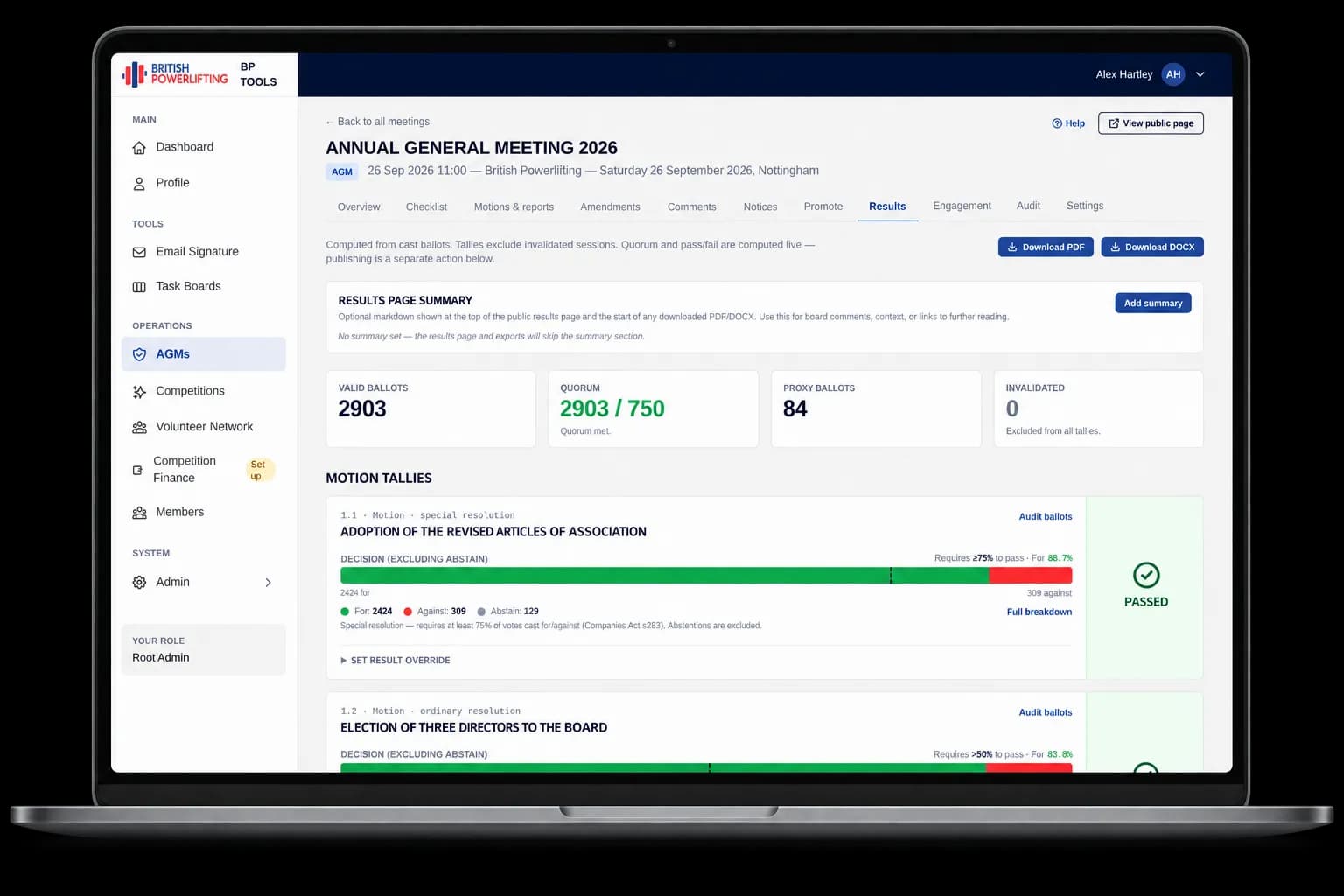
Online AGM & Member Voting
A voting system built inside British Powerlifting's member portal: magic-link ballots, proxy votes, live quorum and an audit trail built to the Articles of Association.
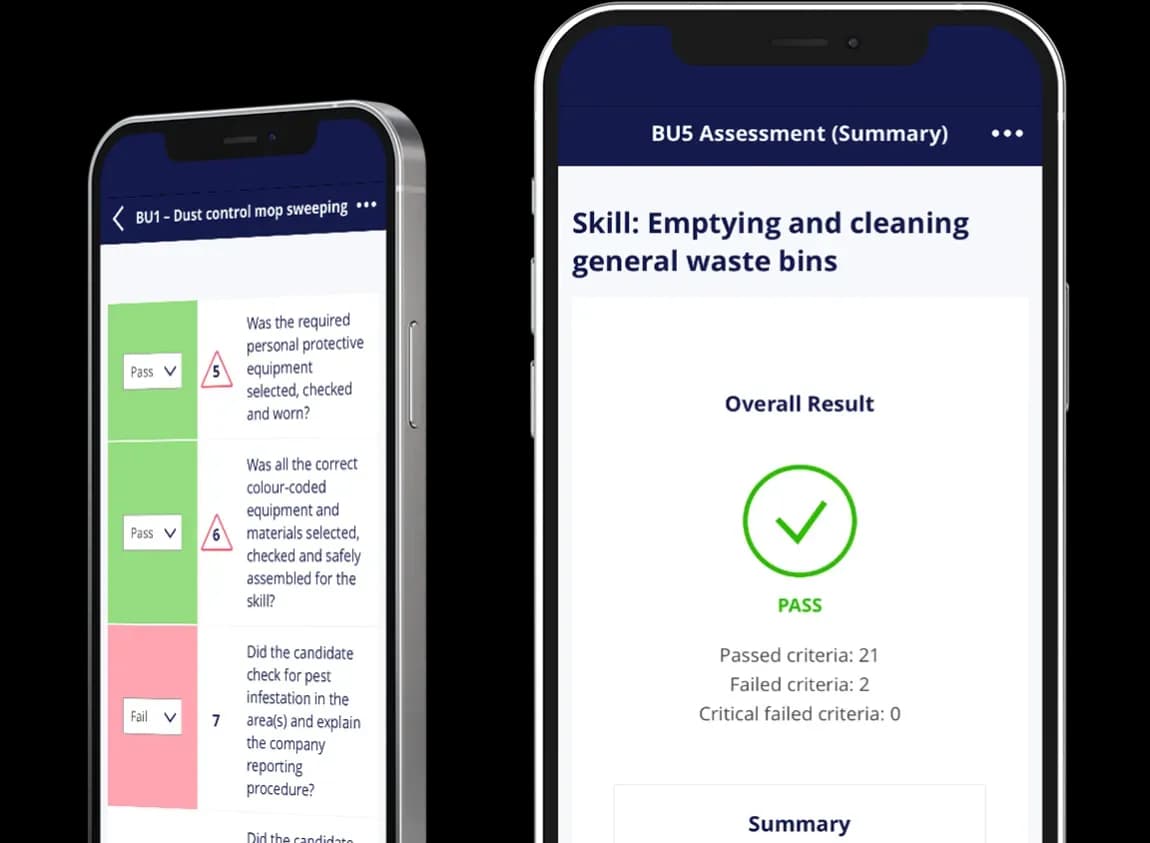
BICSc Cleaning Audit Apps
Mobile assessment apps and a back-office web application for the British Institute of Cleaning Science, used by over 700 registered auditors.
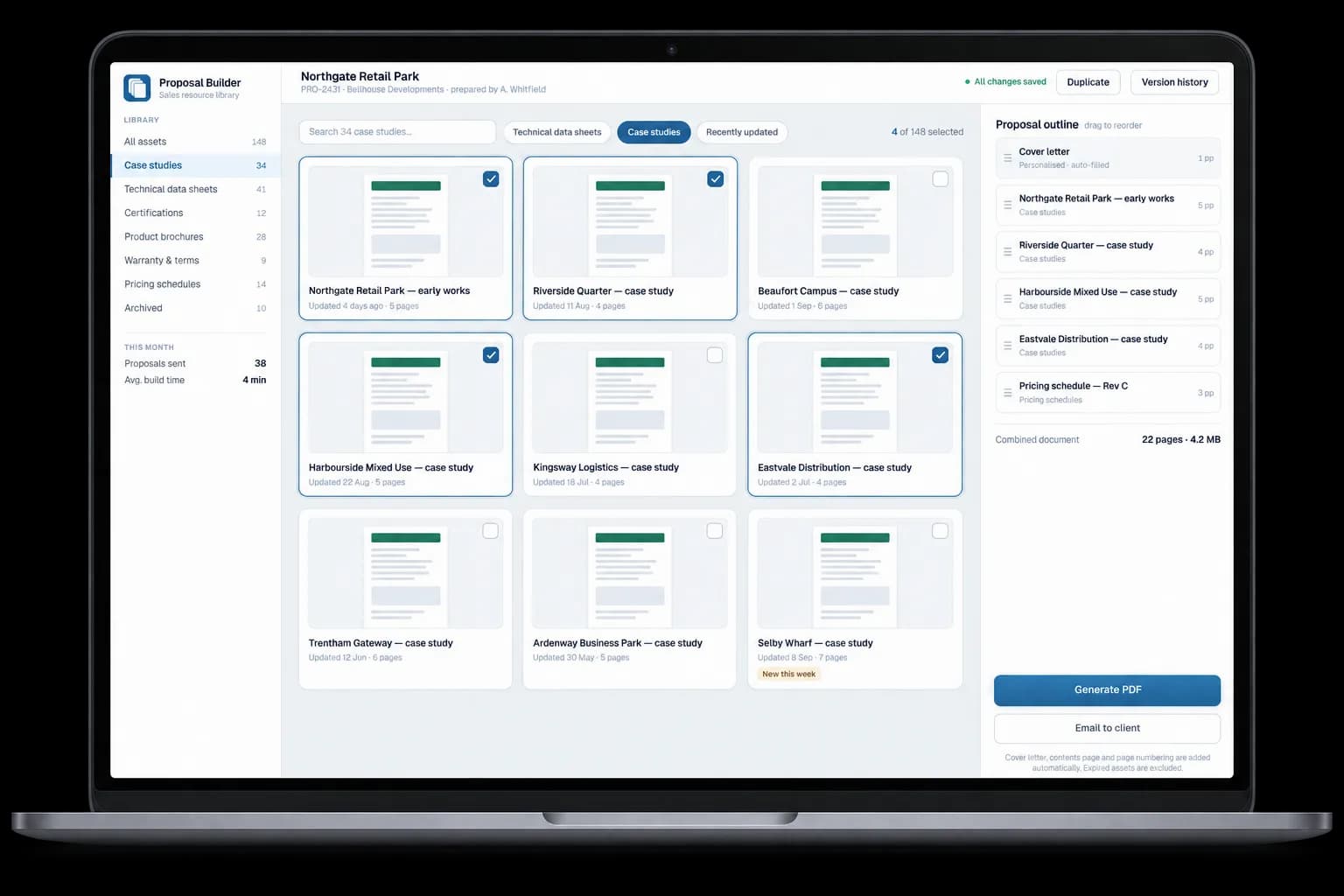
ECA Proposal Generator
A portal for the Electrical Contractors' Association that builds targeted proposals automatically from a library of approved PDF assets.
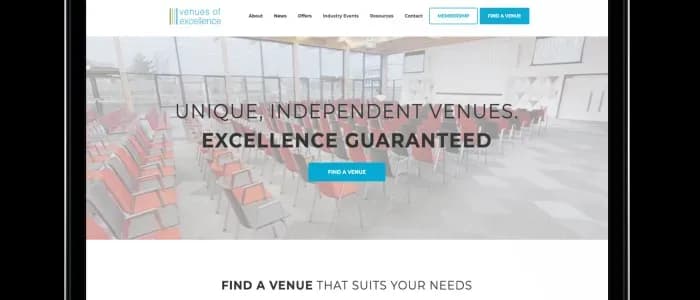
Venues of Excellence
A vetted specialist venue finder with configurable search, mapped listings and a members' portal carrying exclusive content and a job board.
Where AI Is Genuinely Useful to a Membership Body
Two areas where the technology earns its place, and the constraint that shapes both.

Answering member questions from your own material
The most defensible AI use case in a membership body is the one that starts with content you already own. A professional body typically sits on a large library of standards, guidance notes, technical bulletins, codes of practice and past answers — material members pay to have access to, and which staff spend real time looking things up in.
An assistant grounded in that library can answer a member's question with a citation back to the source document, rather than from general knowledge. The same approach powers better search across member resources, where members rarely know the internal name of the document they need, and enquiry triage, where an inbound message can be classified, routed to the right team and drafted against precedent before a human ever opens it.
We build this as a retrieval system with the organisation's own corpus behind it — see AI agent development for how those are put together.

Drafting, summarising and the limits of both
The second cluster of genuinely useful work is drafting. Assessment reports, audit summaries and evidence write-ups follow a predictable structure and consume a disproportionate amount of an assessor's day. A model given the structured result of an assessment and the evidence attached to it can produce a first draft in the house style far faster than a person can start from a blank page.
Summarising works in the same direction: pulling the shape of a set of audit findings out of a quarter's worth of records, or condensing a long piece of correspondence before it reaches a committee.
Two honest caveats. First, a professional body's authority rests on being right, so anything that carries the organisation's name should be reviewed by a person before it goes out — that is a design constraint, not a disclaimer, and it changes how the workflow is built. Second, this only works if the AI is wired into the systems that hold the data; a chatbot bolted onto a website with no access to the membership record cannot do any of it. We cover that plumbing under AI integration.
Rapid results with VelocitySprint®
Pay for output, not hours.
Our VelocitySprint® process accelerates your app development. Each deliverable is scoped, tracked and quality-checked in OutputUnit® units — a unit of finished work rather than time spent. You see progress daily, and Escape Hatch Friday™ means you are never locked into a sprint that stopped making sense on Tuesday.
Discovery & scoping
Focused workshops define the essential features of your MVP. You'll leave with clarity on scope, timeline and budget, without delays.
Sprint-based builds
Our UK developers work in short, high-speed sprints to deliver working prototypes quickly. You'll see progress fast, with daily updates.
Launch & validate — fast
Get your MVP live in weeks, not months. Test with real users, gather feedback and pivot rapidly, so your idea starts delivering value sooner.
What Our Clients Say
Scorchsoft helped us take our idea for an app and make it a reality. Everything from the planning meeting to decide what we really needed to the project management and execution was great. It was delivered on time - early in fact - and on budget. Highly recommend.
 Rebecca PalserDragonfly Intelligence
Scorchsoft is a brilliant company with fantastic knowledge of the mobile app industry. From the project management to the development team, they have been the perfect candidate for our project, and we can't thank them enough!
 Lance ChorltonGapped Online
We're really pleased with the work Scorchsoft has done in developing our web portal! They have been accurate with timelines and budget, delivering a solid product that allows us to monitor and manage patients remotely while they use our novel medical device at-home. The "plan - design - build" approach has worked well and saved us time in the long-run by catching requirements and issues early.
 Daniel GreenSensTrain
I'm really pleased with how my app came out, it was exactly what I was looking for. The team at Scorchsoft are great at what they do and made the whole process as simple and easy as possible. Being someone who is not very tech savvy the set up and back end operations were done in a great easy to use manner even for myself which makes using my app stress free. Thanks to all the team!
 Ruben CarrollMosaic Masterpieces
The new Flourish Education website has already removed a lot of manual processes, freeing up both schools, candidates and internal employees time. We are delighted with the look and feel which is clean, professional and more engaging. We are also pleased with the decision to have an HD video background on the homepage, and building immediate trust with our clients by giving them a taste of what it looks like in the Flourish Education offices.
James HancocksMarketing Manager, Flourish Education I can't believe how quickly we started to see results with this project. Scorchsoft provided us with graphic-designed mockups of how the app would look once built, and we were able to sell the product for use by our first customer before the product was finished. Since launching in March, we have secured a major television network as a client who now uses Image Approvals to manage the talent approval process for their productions.
Aimee SpinksMD, ImageApprovals.com
Thinking About Replacing Your Membership System?
Tell us how your membership, accreditation or renewal process works today. We will come back with a view on what is worth building, what is worth buying, and a realistic cost range.
Membership Software Questions
The questions professional bodies, trade associations and membership organisations ask us most often.
Membership management software is the system that holds your member records and the processes attached to them: joining and renewal, subscription payments, grades and eligibility, communications, and access to members-only content. In a professional body it usually extends further, into accreditation, assessment records and CPD. The distinguishing feature is that several different audiences — members, staff, assessors, branches — read and write the same underlying data through different permissions.
Buy where your process is ordinary and build where it is not. Contact records, mailings and simple subscription renewals are well served by existing products and rarely worth writing from scratch. Bespoke development pays for itself when the organisation's distinctive process — an accreditation scheme, a specific assessment methodology, a vetting standard — is the thing the software has to model, because that is exactly what an off-the-shelf system cannot bend to. Plenty of our work sits alongside an existing system rather than replacing it, connected through system integration.
Yes, and it is one of the most common requests we get from membership bodies. We built the assessment apps for the British Institute of Cleaning Science, which give assessors and verifiers digital versions of the marking sheets they previously carried on paper, with results returning to the institute without the typing-up delay. Field use raises questions worth settling early — what happens with no signal, how evidence such as photographs is captured, and who is allowed to verify whom.
By making access part of the data model rather than the page templates. That typically means three tiers at minimum: public marketing content, members-only resources, and content restricted to a specific group within the membership. The Banknote Watch system is a working example of the third case — it delivers police-only news alongside public content, using restricted registration and permissions-driven publishing. Read more about how we approach access control and sign-in.
Usually, yes. Most membership projects we take on involve at least one system that is staying — a finance package, a CRM, a legacy membership database, or a mailing platform. The practical question is what the system exposes: a documented API is straightforward, a scheduled data export is workable, and a closed product with neither needs a different plan. We look at that before proposing an architecture.
Yes. Recurring subscriptions, part-year joining, grade changes mid-term and lapse-and-reinstate are the usual complications, and they are worth mapping properly before any code is written because they determine how the payment provider is configured. We integrate established payment providers rather than handling card data ourselves — see online and in-app payments.
It can, provided the answers are grounded in your documents and cite them, rather than generated from a model's general knowledge. That distinction matters more for a professional body than for most organisations, because your authority depends on the answer being right. In practice we build these as retrieval systems over your own corpus, with a human review step for anything that goes out under the organisation's name.
It depends almost entirely on how many audiences the system serves and how unusual your process is. A single-audience member portal with standard renewals is a materially smaller piece of work than a multi-role accreditation platform with field apps and a public directory. Our guide on what an app costs to build explains how we size this, and a short call will usually get you to a realistic range.
Need help building your ideas?
Tell us where you're headed and we'll come back with our thoughts, a realistic plan and a rough cost estimate. Scorchsoft is a UK-based team of app, portal and AI developers, working in-house from Birmingham's Jewellery Quarter.