
Bespoke software vs off-the-shelf: how to decide
A decision guide for business and operations leaders: when buying a product beats building one, when it does not, the costs both options hide, and a test you can run against your own process this week.
- Author
- Andrew Ward
- Managing Director
- Last reviewed
- Reading time
- 9 min

In this guide
In summary
Bespoke software is built specifically for one organisation's process; off-the-shelf software is a product many organisations licence and adapt to. Neither is better in general — the right answer depends on whether the process you are automating is a competitive advantage or just overhead. This guide gives you the comparison, the costs each side tends to hide, and a test you can run against your own process before you talk to any supplier.
Key takeaways
- Buy off the shelf when the process is overhead; build when the process is the advantage. That single question decides most cases.
- Off-the-shelf is cheaper to start and more expensive to leave. Per-user licensing scales with headcount whether or not the value does.
- The hidden cost of buying is process distortion; the hidden cost of building is ownership. Both are real and neither appears on a quote.
- The UK government's own Technology Code of Practice tells departments to reuse or buy before building, and to define a purchasing strategy first.
- Buying a product and then paying for heavy customisation often costs more than a bespoke build and leaves you unable to upgrade.
The difference, in one paragraph
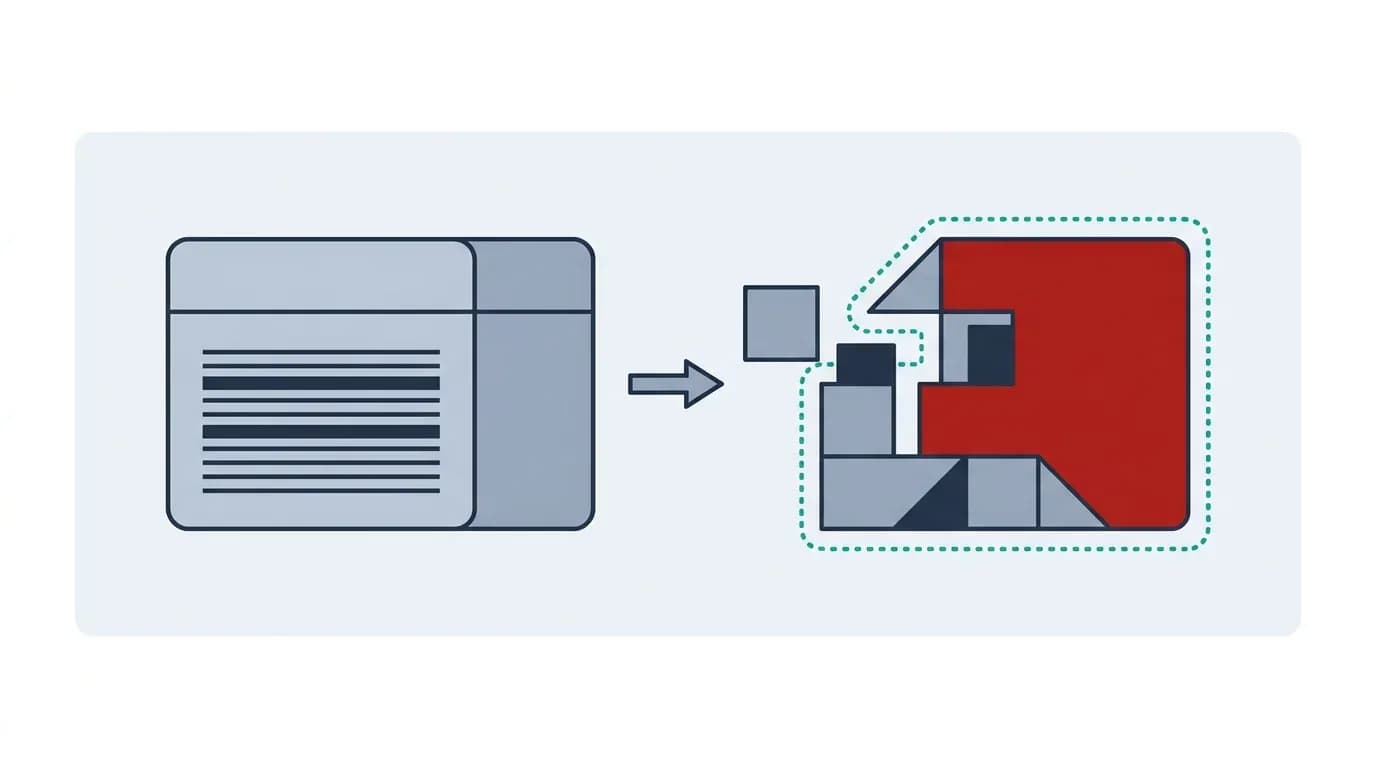
Bespoke software is built specifically for one organisation, to fit a process that organisation already has. Off-the-shelf software is a product built once and licensed to many organisations, which adapt their process to fit it. Everything else — cost, speed, risk, who owns what — follows from that one structural difference.
It is worth being precise about a third category, because it is where most confusion sits. A configurable platform is off-the-shelf software with settings: you can change fields, workflows and branding without writing code, but you cannot change what the product fundamentally does. That is still buying, not building, and it carries the buying trade-offs even when the configuration work feels like a project.
The question is not which approach is better. Both are correct in different places, and most businesses of any size end up running both. The question is which one fits this process, and the rest of this guide is a way of answering that without a supplier in the room.
Where off-the-shelf wins
Buy when your process is close to a common pattern. Payroll, accounting, email, CRM, helpdesk ticketing, e-signature: thousands of organisations do these in broadly the same way, a mature market exists, and the product has already absorbed edge cases you have not thought of yet.
The advantages are real and worth naming:
- Speed. You can be running this month rather than next quarter.
- Shared development cost. The vendor's roadmap is funded by every other customer, so you get improvements you did not pay for individually.
- Lower up-front outlay, which matters when the business case is unproven.
- Someone else carries the maintenance, including security patching and compliance updates.
This is not just a commercial preference. The UK government's own Technology Code of Practice tells departments to share and reuse rather than duplicate effort, and to define a purchasing strategy before committing — sensible discipline for a private business too.
One caution: buying does not transfer responsibility. Under the shared responsibility model NCSC sets out for cloud services, your supplier secures the platform and you remain responsible for your configuration, access control and data. The same is true of data protection: buying a product does not make the vendor accountable for how you use personal data.
Where bespoke wins
Build when the process is genuinely yours, and when doing it your way is part of why customers choose you.
In practice that looks like one of four situations. Your workflow has no off-the-shelf equivalent — an unusual approval hierarchy, a sector-specific compliance step, a pricing model nobody else uses. You are already paying several people to move data between products by hand, and the integration is the actual problem. You need to charge for access, in which case the software is the product. Or you have hit a ceiling: the product you bought cannot do the next thing, and the vendor has no plans to add it.
The advantages are the mirror image of buying. It fits the process exactly, so nobody works around it. You own it, so no vendor can change the price, the terms or the roadmap under you. It can integrate with anything you run rather than only what a vendor exposes. And it can become an asset on your balance sheet rather than a recurring cost.
On custom software projects we have found the strongest signal is not frustration with a product's features. It is the existence of a spreadsheet that people maintain alongside the product, because the product cannot hold something the business genuinely needs. That spreadsheet is usually the specification for the bespoke build.
Side by side
The trade-offs are consistent enough to tabulate. Read it as two columns of consequences rather than a scorecard, though: one row that genuinely matters to your business outweighs five that do not, and almost nobody weighs these equally.
- Time to first use. Off-the-shelf: days to weeks. Bespoke: weeks to months.
- Up-front cost. Off-the-shelf: low. Bespoke: higher, as the cost section below sets out.
- Ongoing cost. Off-the-shelf: a per-user licence, indefinitely, rising with headcount. Bespoke: hosting plus whatever support you choose to buy.
- Process fit. Off-the-shelf: you adapt to the tool. Bespoke: the tool fits your process.
- Integration. Off-the-shelf: only what the vendor exposes. Bespoke: anything with an API or a database.
- Competitive differentiation. Off-the-shelf: none, because competitors can buy the same thing. Bespoke: yours.
- Who fixes it. Off-the-shelf: the vendor, on their timetable. Bespoke: you or your development partner, on yours.
- Exit. Off-the-shelf: migrating out can be hard, so check data portability before committing. Bespoke: you hold the code and the data.
- Best for. Off-the-shelf: overhead, the work that has to happen but wins nothing. Bespoke: advantage, the work that wins the contract.
The last row is the one to argue about first. If you cannot decide whether the process is overhead or advantage, no other row will settle it for you.
The costs both sides forget
Neither route costs what the quote says, and the omissions are predictable.
Off-the-shelf hides process distortion. The licence fee is visible; the workaround is not. When a product cannot do something the business needs, the cost reappears as a spreadsheet, a rekeying job, or a person whose role is partly to bridge two systems. That cost is real, recurring and almost never attributed to the software decision that caused it. Per-user licensing also scales with headcount rather than with value, so a tool that was sensible at twelve staff can be indefensible at eighty.
Bespoke hides ownership. The build is a project with an end date; the software is not. It needs hosting, monitoring, dependency updates, security patching and someone to decide what gets built next. A bespoke system with no owner degrades into exactly the legacy problem it was built to replace. Budget for that from the start — ongoing support is part of the cost of building, not an optional extra.
Two more items belong on both sides of the ledger. Check your exit before you commit: the government's open standards principles exist precisely because data trapped in a proprietary format is a cost you only discover when leaving. And whichever route you take, you remain the data controller for personal data — the ICO's UK GDPR guidance applies to a bought product exactly as it applies to one you built.
A decision test you can run this week
You do not need a supplier to work this out. Take the process in question and answer five things honestly:
- Is this process an advantage or overhead? Would a customer ever choose you because of how you do it? If no, buy.
- Does a product already do 80% of it? Not 80% of the features — 80% of the outcome. If yes, buy, and change your process to match.
- What are people doing outside the system today? List every spreadsheet and rekeying step. If that list is long, the gap is structural, not a training issue.
- How many people will use it in three years, and what does the licence cost then? Multiply it out. Per-user pricing decisions look different over a five-year horizon.
- What happens if the vendor doubles the price or discontinues it? If the answer is "the business stops", you are buying a dependency, not a tool.
Answer those and the decision usually makes itself. Where it does not, the honest conclusion is often that this process is not ready to be automated at all — which is a cheaper discovery to make now than after a build.
What bespoke costs and how long it takes
We publish a floor rather than a price list, because the number depends entirely on scope. Our quote page says it plainly: apps and portals take hundreds of hours to design and build, so a bespoke project under £7.5k is unlikely, and most of our projects are more than that.
On timing, in our projects bespoke work is delivered in fixed two-week Velocity Sprints, and most projects aim to launch a usable first version within 2 to 8 weeks — typically 2 to 4 sprints, committed one at a time rather than all at once. For a larger fixed-scope programme we typically recommend delivering a brand-new project within three to six months; past six months, our experience is that you are usually defining too many requirements for one release.
Payment normally tracks delivery. The worked example on our quote page is a £20,000 project over three months, split into four payments: a deposit, then one at the end of each month. Before any of that, Quickstart App Planning produces the scope and the estimate, and typically completes within 3 to 6 weeks.
The hybrid most businesses end up with
The framing of "bespoke or off-the-shelf" is usually false by the time you have more than a handful of systems. The common and sensible end state is to buy the commodities and build the connective tissue.
That means licensing a product for accounting, payroll, email and CRM — because those are overhead and the market is mature — and building the thing that is specifically yours: the customer-facing portal, the pricing engine, the compliance workflow, or the integration layer that makes the bought products behave as one system.
There is one hybrid to be wary of, and it catches people repeatedly: buying a product and then commissioning heavy customisation of it. It frequently costs more than building outright, and it strands you — you cannot take the vendor's upgrades without breaking your customisations, so you end up maintaining a private fork of someone else's product. If a product needs that much work to fit, it is the wrong product, and the customisation budget is the build budget.
What actually decides it
In the conversations we have with clients, the decision almost never turns on a feature comparison. It turns on how strategic the process is, and how much the business is currently paying in people's time to paper over a gap.
So make the strategic call first and price it second. If the process is overhead, buy the cheapest thing that covers 80% of the outcome and move on — building it would be an expensive way to be the same as everyone else. If the process is genuinely how you win, buying it forces you to work like your competitors, and no amount of configuration gets that advantage back.
If you would like help making that call on a specific process, book a free consultation. We build bespoke software, and we will still tell you when a product off the shelf is the better answer — that conversation costs you nothing and occasionally saves a great deal.
Frequently asked questions
Bespoke software is built for one organisation to fit a process it already has. Off-the-shelf software is a product licensed to many organisations, which adapt their processes to fit it. A configurable platform still counts as off-the-shelf: you can change settings, but not what the product fundamentally does.
More expensive up front, and not always over time. Off-the-shelf costs a per-user licence indefinitely, which scales with headcount rather than value, and its workarounds cost staff time that rarely gets attributed to the software. Bespoke costs more to build and then costs hosting plus whatever support you choose.
When the process is overhead rather than advantage, and a mature product already delivers about 80% of the outcome. Payroll, accounting, email and standard CRM are almost always better bought. Building them is an expensive way to end up the same as your competitors, with maintenance you now own.
You can, and it is the hybrid we would most often warn against. Heavy customisation frequently costs more than building outright and strands you on a private fork of someone else's product, unable to take their upgrades. If a product needs that much work to fit, it is the wrong product.
Ask whether a customer would ever choose you because of how you run this process. If not, buy. Then list what staff currently do outside the system in spreadsheets and rekeying — a long list means the gap is structural, not a training problem, and that is when building earns its cost.
Terms used in this guide
Key topics covered
- What bespoke and off-the-shelf mean
- Where each option wins
- Side-by-side comparison
- Total cost of ownership
- Licensing and lock-in
- The advantage-vs-overhead test
- What bespoke costs
- Hybrid approaches
- Data protection and exit
Sources referenced
Not sure which way to go?
Tell us about the process and we will give you a straight answer — including when buying a product off the shelf is the better call.

About the author
Andrew Ward
Managing Director
Andrew Ward is the founder and Managing Director of Scorchsoft and author of The Control Standard, Execute Your Tech Idea and The ChatGPT Guide for Business. With more than sixteen years of experience building software and running a business, he writes about practical ways to apply technology, use AI and lead teams that deliver.
Andrew holds a first-class degree in Computer Science with Business Management from the University of Birmingham and has represented Great Britain in bench press, winning world championship bronze in 2023.
Want to talk about your project?
Tell us what you’re trying to achieve and we’ll map the fastest credible path.