
Healthcare App & AI Development
We build the software that healthcare and care organisations actually run on — apps for carers and clinicians, patient and staff portals, integrations with the systems you already have, and AI applied where it genuinely helps.

Building for teams across healthcare, logistics, motorsport and manufacturing






Healthcare software is won or lost on the details
Most healthcare and care organisations are not short of ideas. They need the thing they already do every day — a medication round, a prescription reorder, a post-fall check, an appraisal cycle, a stock count — to stop depending on a paper form, a shared spreadsheet and somebody remembering to chase it.
That is a solvable software problem. What makes it harder than a comparable build in another sector is everything around it.
- Patient and service-user data is the first design constraint, not the last. Who can see a record, what gets written to the audit log, where the data is hosted and how long it is kept all shape the data model before a single screen is designed. Retro-fitting that is expensive, which is why it belongs in the first workshop alongside data encryption and an independent penetration test before go-live.
- The people using it are rarely at a desk. Carers, community nurses and paramedics use a phone one-handed, mid-visit, sometimes with no signal at all. Offline behaviour, large touch targets and a flow that survives being interrupted matter far more than a dense dashboard.
- Nobody works in a single system. A tool that cannot read from or write to your practice, rostering, stock or finance systems just becomes a second place to type the same information. Most of the value in a healthcare build sits in integration with the systems you already run.
- Four audiences share one record. Clinicians, carers, administrators and patients or families each need a different slice of the same data, with role-based access and single sign-on drawing the lines and proving who saw what.
- The spreadsheet is load-bearing. Rotas, waiting lists, equipment registers and audit returns often run on one workbook that a handful of people understand. Turning that into a proper application removes the key-person risk without asking anyone to change how they think about the work.
- Hardware is part of the workflow. Pressure sensors, monitoring devices and wearables produce data that only becomes useful once an app pairs with them, stores the readings and shows a trend. That is connected device and sensor work, and it is more common in this sector than in almost any other.
We are a software development company, not a clinical safety or regulatory consultancy. Where a project touches clinical safety classification, information governance sign-off or procurement frameworks, we work alongside the people in your organisation who own those responsibilities, and we scope the build so their decisions are not blocked by ours.
What we build for healthcare and care organisations
The pieces most healthcare and care projects are assembled from. Each one links to how we approach it.
Healthcare and care work we have delivered
Four projects for UK healthcare manufacturers, suppliers and clinicians: an app used after a fall, a connected pressure-sensing cushion, a prescription and ordering platform, and a feedback portal for doctors.
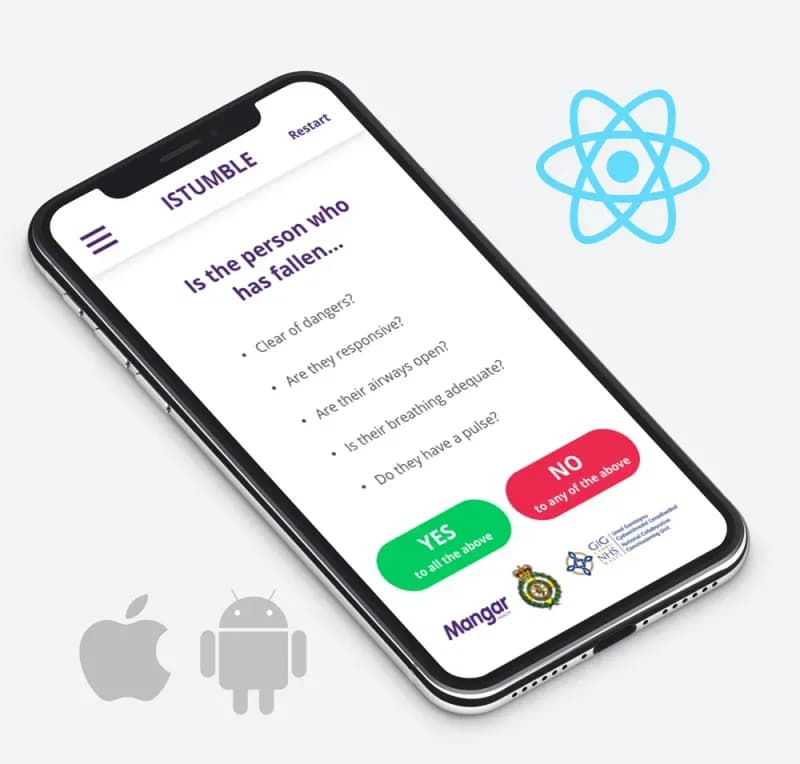
iStumble post-fall app
A React Native app for Mangar Health that walks a carer through a post-fall check, with offline data and video guidance built into the question flow.
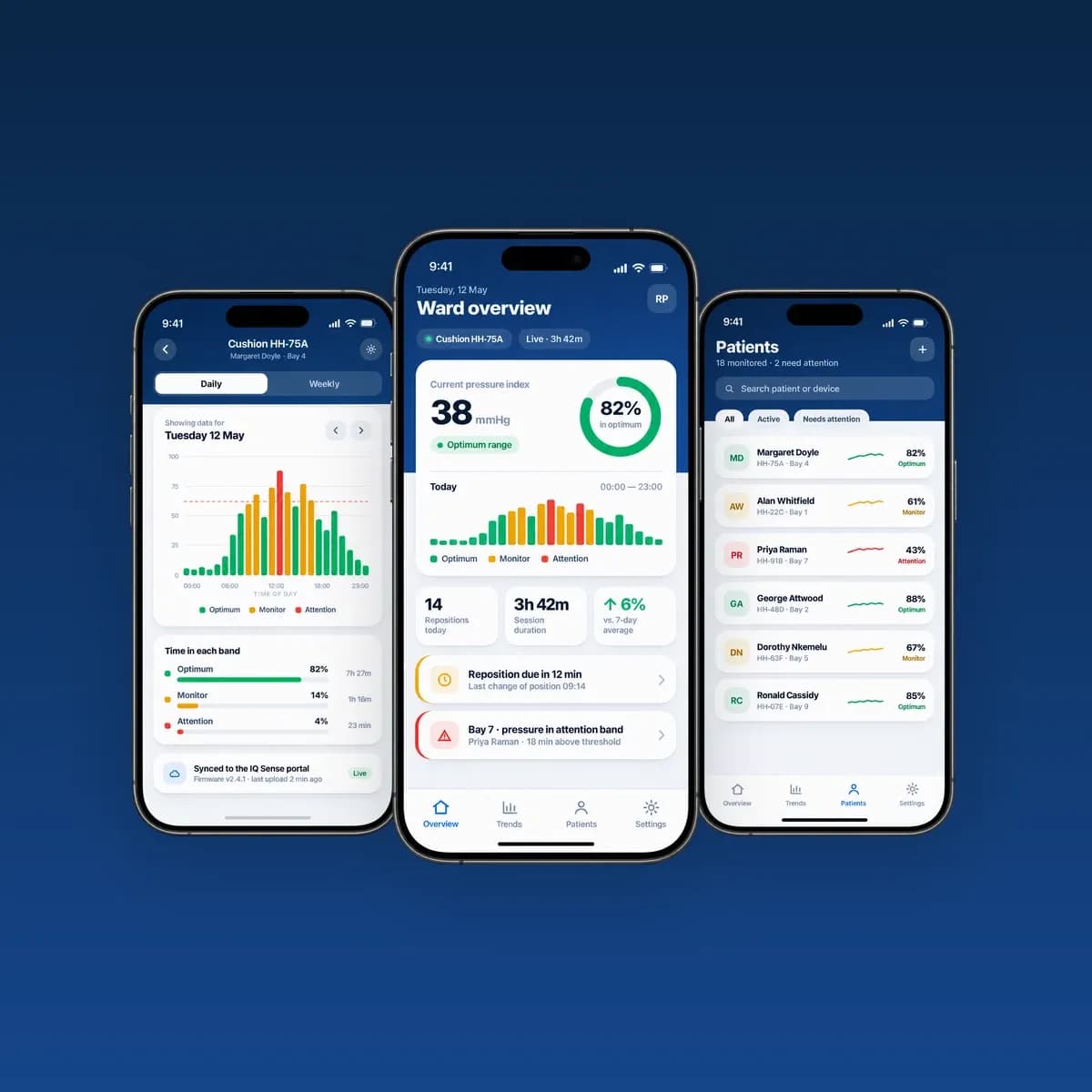
Helping Hands IQ Sense
An IoT build for a pressure-sensing care cushion: firmware integration over Bluetooth, a React Native clinician app, and the cloud portal readings sync to.
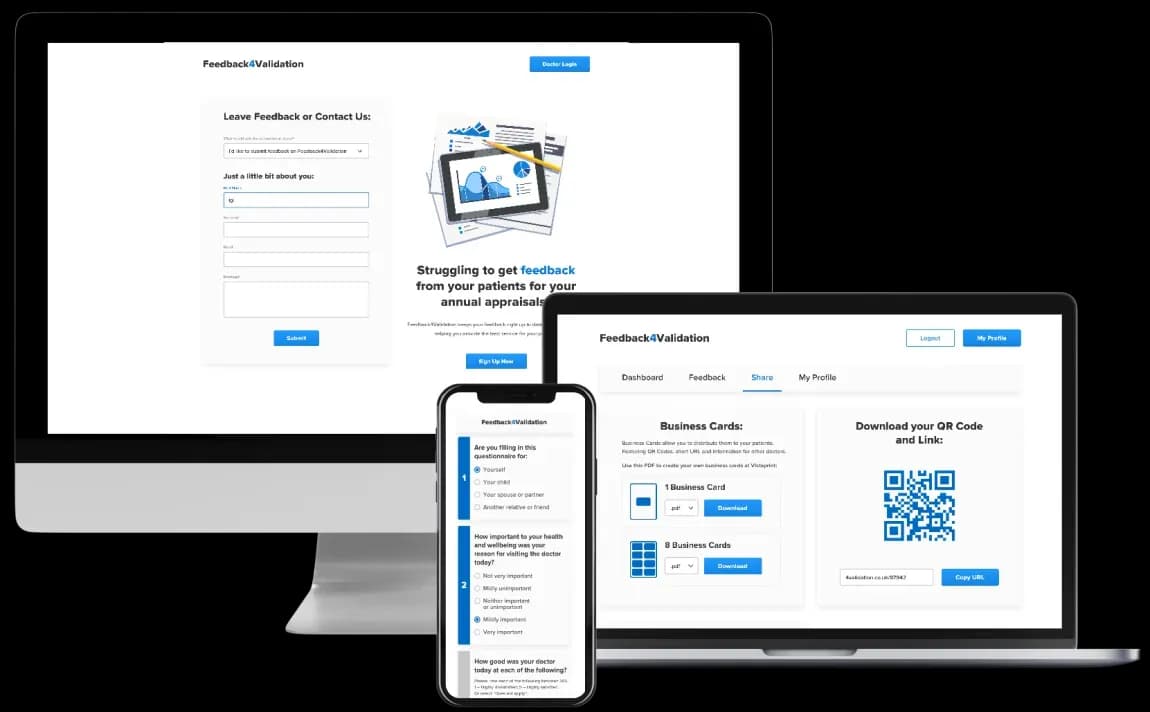
Feedback4Validation
A secure web app that helps doctors collect patient feedback for appraisal and revalidation, with a doctor dashboard, QR codes and share links.
AI for healthcare, minus the hype
The applications working today in healthcare and care are administrative and document-heavy. They sit beside the clinician rather than in front of the patient.

Take the paperwork load off clinical and care staff
The clearest wins are the ones furthest from a clinical decision. Referral letters, assessment forms, consent paperwork, supplier invoices, CQC evidence and handwritten notes all arrive as documents that somebody has to read, classify and re-key into another system.
Language models handle that well enough to be worth building, as long as a person still signs the result off. In practice that means extracting fields from a scanned form, drafting a summary of a long case note for a human to correct, routing an incoming referral to the right team, or answering a "what does our policy say about this" question with the source paragraph shown next to the answer.
We build these as features inside software your teams already open, rather than as a separate assistant nobody remembers to use. See AI integration for adding them to an existing system, automated document creation for the output side, and AI automation for the back-office processes around it.

Keep a person in the loop, and keep the evidence
Anything touching a patient or service-user record has to be defensible afterwards. So the useful design question is rarely "can the model do this". It is "who approved it, what were they shown at the time, and can we reconstruct that in six months".
That shapes the build. The model proposes, a named person accepts, edits or rejects, and both the suggestion and the decision are written to an audit trail. Answers are grounded in your own documents rather than the model's general knowledge, with the source visible beside the output so a reviewer can check it in seconds rather than taking it on trust.
We are deliberately conservative about where this stops. We build administrative and information-handling software. We do not build tools that make, grade or replace clinical decisions, and any project heading that way needs a regulatory route and clinical governance that sit well outside a development contract. If you are still working out where AI would repay the effort, an AI consultancy session is a much cheaper first step than a build.
Rapid results with Velocity Sprints
Pay for output, not hours.
Our Velocity Sprints process accelerates your app development. Each deliverable is scoped, tracked and quality-checked in Output Units — a unit of finished work rather than time spent. You see progress daily, and Escape Hatch Friday™ means you are never locked into a sprint that stopped making sense on Tuesday.
Discovery & scoping
Focused workshops define the essential features of your MVP. You'll leave with clarity on scope, timeline and budget, without delays.
Sprint-based builds
Our UK developers work in short, high-speed sprints to deliver working prototypes quickly. You'll see progress fast, with daily updates.
Launch & validate — fast
Get your MVP live in weeks, not months. Test with real users, gather feedback and pivot rapidly, so your idea starts delivering value sooner.
What Our Clients Say
Scorchsoft helped us take our idea for an app and make it a reality. Everything from the planning meeting to decide what we really needed to the project management and execution was great. It was delivered on time - early in fact - and on budget. Highly recommend.
 Rebecca PalserDragonfly Intelligence
Scorchsoft is a brilliant company with fantastic knowledge of the mobile app industry. From the project management to the development team, they have been the perfect candidate for our project, and we can't thank them enough!
 Lance ChorltonGapped Online
We're really pleased with the work Scorchsoft has done in developing our web portal! They have been accurate with timelines and budget, delivering a solid product that allows us to monitor and manage patients remotely while they use our novel medical device at-home. The "plan - design - build" approach has worked well and saved us time in the long-run by catching requirements and issues early.
 Daniel GreenSensTrain
I'm really pleased with how my app came out, it was exactly what I was looking for. The team at Scorchsoft are great at what they do and made the whole process as simple and easy as possible. Being someone who is not very tech savvy the set up and back end operations were done in a great easy to use manner even for myself which makes using my app stress free. Thanks to all the team!
 Ruben CarrollMosaic Masterpieces
The new Flourish Education website has already removed a lot of manual processes, freeing up both schools, candidates and internal employees time. We are delighted with the look and feel which is clean, professional and more engaging. We are also pleased with the decision to have an HD video background on the homepage, and building immediate trust with our clients by giving them a taste of what it looks like in the Flourish Education offices.
James HancocksMarketing Manager, Flourish Education I can't believe how quickly we started to see results with this project. Scorchsoft provided us with graphic-designed mockups of how the app would look once built, and we were able to sell the product for use by our first customer before the product was finished. Since launching in March, we have secured a major television network as a client who now uses Image Approvals to manage the talent approval process for their productions.
Aimee SpinksMD, ImageApprovals.com
Thinking about a healthcare or care app?
Tell us what the process looks like today — who does what, on which form, and where it gets stuck. We will tell you what is worth building, roughly what it would cost, and what to do first.
Healthcare and care software questions
The questions providers, manufacturers and clinicians ask us most often.
Yes. We have delivered apps and web platforms used by carers, clinicians and healthcare suppliers, including systems that hold patient and customer records for organisations serving both public and private healthcare. We are a software development company rather than an accredited healthcare supplier, so where a project needs a procurement framework place, a formal information-governance assessment or clinical safety sign-off, we build to support that process and work alongside whoever in your organisation owns it.
Care home software is the set of tools a residential or domiciliary provider uses to run day-to-day care: care plans, daily notes, medication records, incident logs, staff rotas, and updates for families. Plenty of providers are well served by an off-the-shelf system, and we will say so if that is the case. A custom build earns its place when you run a service the market products do not cover, or when the existing product will not integrate with your finance, rostering or clinical tools.
We agree the data model, the retention rules and the hosting region before development starts, because all three are hard to change later. Access is role-based so a carer, clinician, administrator and patient each see only their slice of a record, sensitive fields are encrypted, and changes are written to an audit trail. We recommend an independent penetration test before go-live, and we are happy for your information governance lead to review the architecture while it is still cheap to alter.
It usually has to. Community visits, care homes with thick walls and ambulance work all involve places where mobile data drops out, so we design the app to hold the data it needs locally, let the user complete the task offline, and synchronise when a connection returns. Our iStumble app for Mangar Health caches its content so a carer can run a post-fall check with no connectivity at all.
That is normally where most of the value sits, so it is the first thing we investigate. If the existing system has a documented API we integrate directly; if it does not, the options are usually a scheduled file exchange, a database-level integration agreed with the vendor, or a middleware layer that keeps the two in step. We will tell you early if a supplier's licence terms make a clean integration impossible, because that changes what is worth building.
A focused first version — one workflow, one or two user roles, real data — is typically a matter of weeks rather than months through our rapid MVP development approach, with larger platforms phased from there. Integration work and information governance review are the two things most likely to extend a timeline, so we scope both up front. Our guide to app development costs explains how budgets are usually put together.
For administrative tasks, carefully and with a person approving the output: summarising a long note for a clinician to correct, extracting fields from a scanned form, classifying an incoming referral, or answering a policy question with the source shown. We keep the model's answers grounded in your own documents and log both the suggestion and the human decision. We do not build software that makes or grades clinical decisions, and we will say so rather than take the work.
You are typically assigned the appropriate copyright or licence rights for the bespoke code we write for your project, and we set out those terms for you to review before work begins rather than after. The data stays yours throughout, held in infrastructure under your control or in an account we hand over. We can keep supporting and developing the product afterwards, but that is a choice rather than a dependency we design in.
Need help building your ideas?
Tell us where you're headed and we'll come back with our thoughts, a realistic plan and a rough cost estimate. Scorchsoft is a UK-based team of app, portal and AI developers, working in-house from Birmingham's Jewellery Quarter.