
Professional Services App & AI Development
We build client portals, document automation and AI tools for accountancy practices, law firms and consultancies — software judged on whether it protects fee-earner hours or quietly consumes them.

Building for teams across healthcare, logistics, motorsport and manufacturing
Trusted by 220+ organisations








In professional services, software either protects fee-earner hours or it is overhead
Accountancy practices, law firms, consultancies, advisory businesses and recruiters all sell the same underlying thing: qualified people's time and judgement. That makes the economics unusually blunt. Revenue is broadly hours multiplied by rate multiplied by recovery, and most operational problems in the sector reduce to one of those three numbers leaking somewhere.
So software here has to justify itself differently than it does in, say, retail. A system that adds three minutes of admin to every matter is not a process improvement; it is a standing charge against chargeable time. The tools that earn their place tend to do one of four things — take work off fee-earners, make the status of everything visible without anyone having to ask, produce and distribute documents without manual assembly, or keep the firm's obligations to its clients demonstrably met.
The problems we are asked to solve in this sector are consistent:
- Time recorded late, or from memory. Recovery falls when recording happens on a Friday afternoon rather than as the work happens.
- The "any update?" email. Clients cannot see where their matter, return or engagement has got to, so they ask — and answering costs a fee-earner ten minutes each time.
- Documents assembled by hand. Engagement letters, reports, packs and client deliverables rebuilt from templates every time, reintroducing the same errors.
- Files moving as email attachments. Confidential client material travelling over a channel the firm cannot audit, retain to a policy, or withdraw.
- Systems that do not talk to each other. Practice management, CRM, finance and the document store each hold part of the truth, and somebody rekeys between them.
- No honest view of utilisation. Planned against actual gets reconstructed in a spreadsheet at quarter end, which is far too late to act on.
None of that is exotic, and all of it is tractable with ordinary well-built software. The usual obstacle is that the firm has no spare technical capacity, and every off-the-shelf product assumes a way of working the firm does not have.
What we build for professional services firms
The capabilities that come up most often in accountancy, legal, consultancy and recruitment work. Each links through to how we approach it.
Portals and document tools we have built
Four projects with the same shape as a professional services problem: controlled access to sensitive material, documents that assemble and distribute themselves, and proposals that stop eating fee-earner hours.
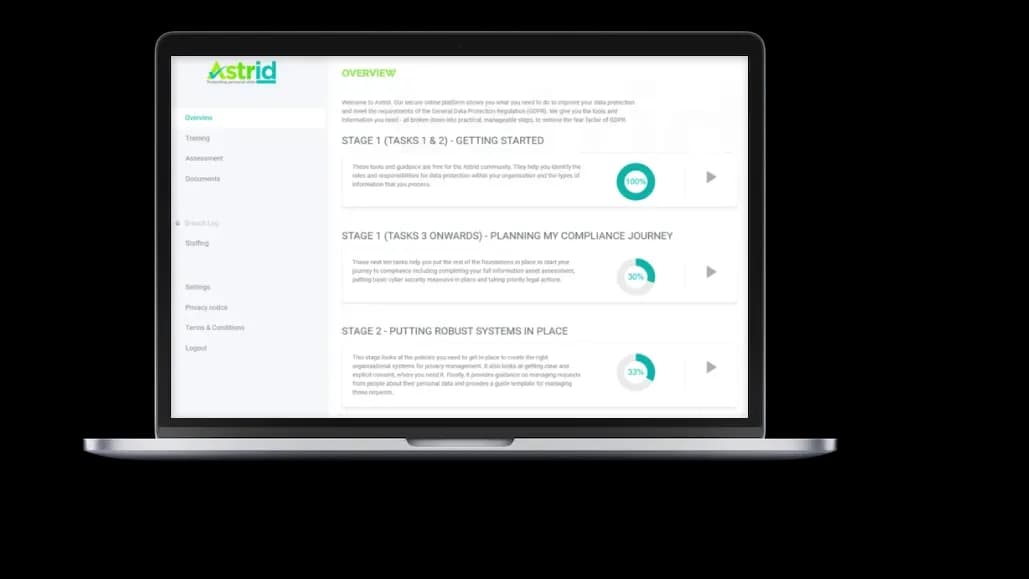
Astrid GDPR SaaS Portal
A compliance portal with staff permissions, encrypted file upload and an audit trail.
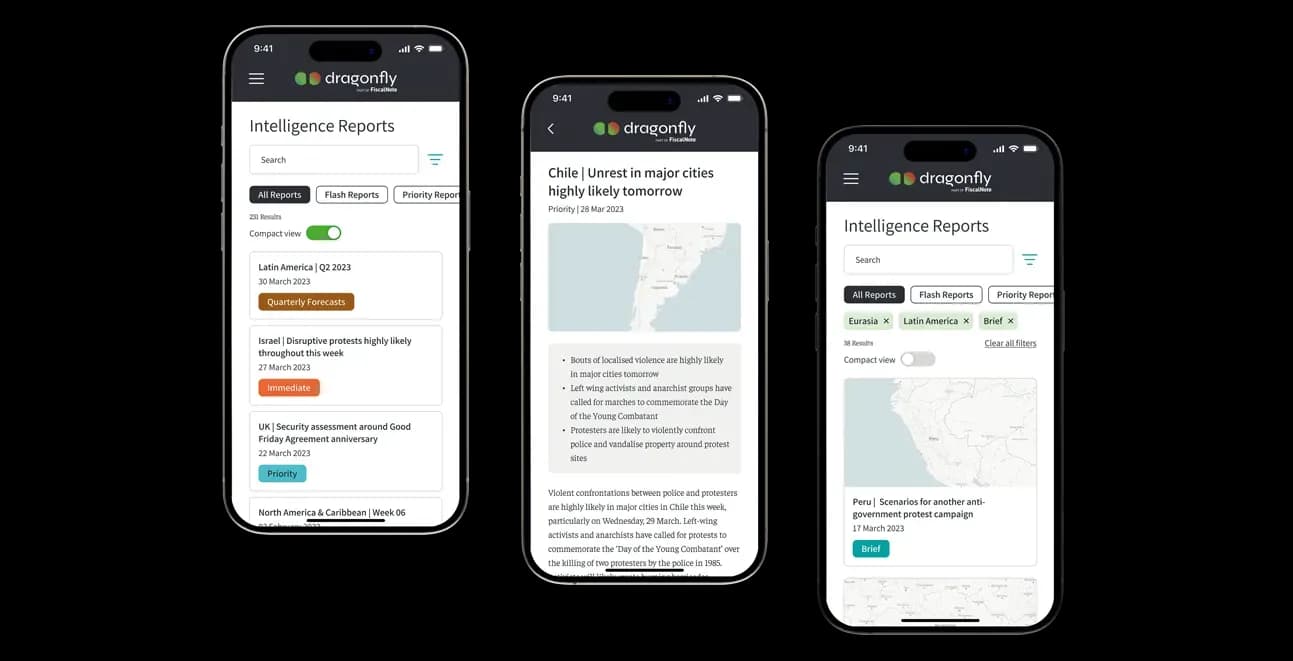
Dragonfly SIAS App
Intelligence reports, risk methodology and briefings delivered to clients on mobile.
Base Solutions Document Portal
Automated distribution of client files, replacing manual sending with a single portal.
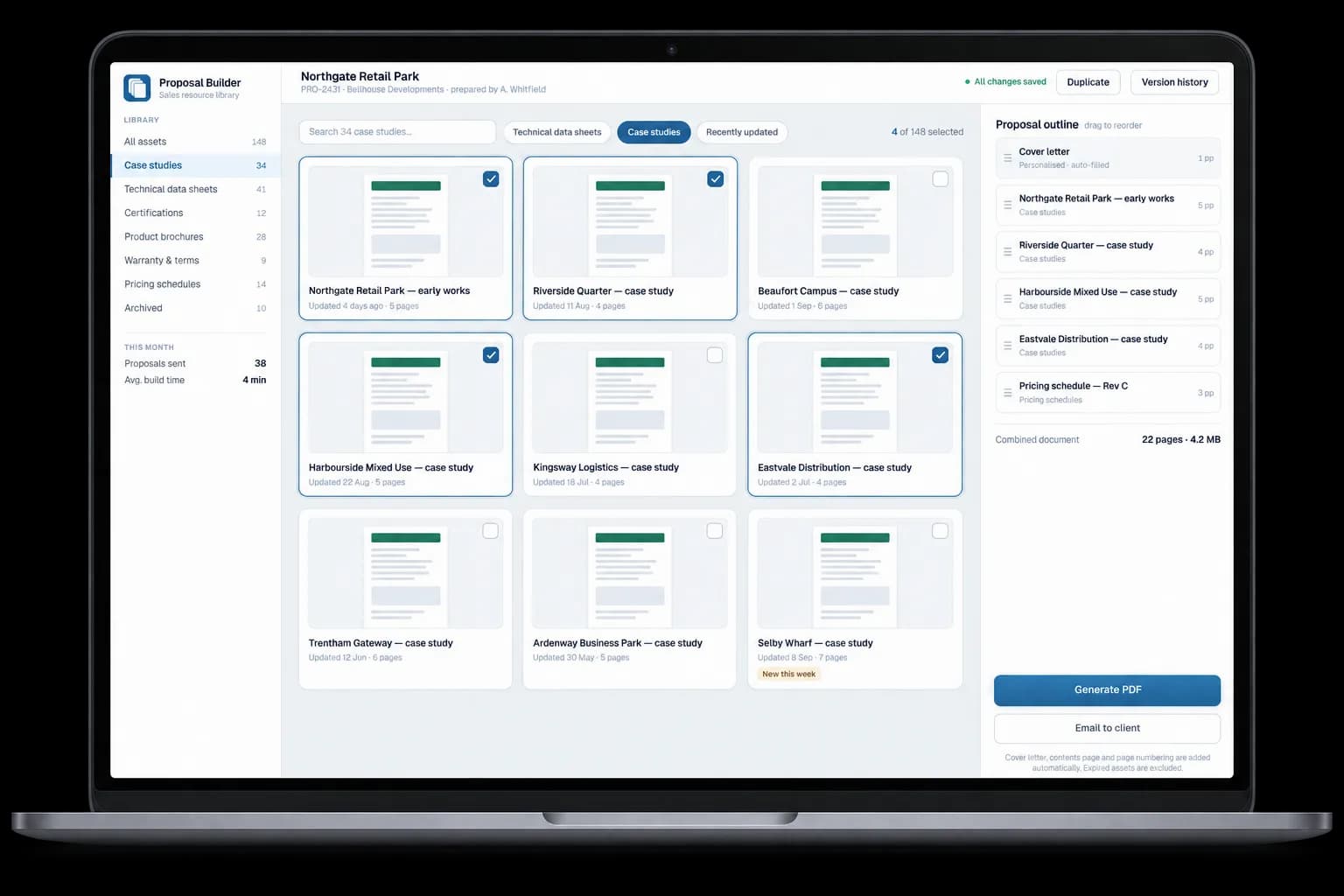
ECA Proposal Generator
A categorised library of approved PDF assets, assembled into a targeted client proposal in minutes rather than hours.
AI in professional services: where it genuinely helps
The honest version. Some of this is already reliable enough to build on; some of it is not, and the difference matters more in a regulated firm than almost anywhere else.

AI for accountants: extraction, categorisation and drafting
The strongest case for AI in an accountancy practice is not advice. It is the volume of document handling that sits underneath advice — invoices, receipts, statements, statutory accounts and client correspondence arriving as unstructured files that somebody has to read, classify and rekey.
Language models are genuinely good at that particular job. In practice we build it as:
- Extraction — pulling dates, totals, VAT, counterparties and references out of documents a client has uploaded, each with a confidence score, and routing anything uncertain to a person.
- Categorisation — proposing a treatment or nominal code from how the practice has coded similar items before, rather than from a generic ruleset.
- Drafting — first-pass client emails, covering letters and query lists that a qualified person edits before anything is sent.
- Answering from the firm's own material — a retrieval-based assistant grounded in the practice's internal guidance and precedent, so an answer cites its source instead of inventing one.
- Summarising long filings — reducing a lengthy set of accounts or a policy document to the points a reviewer needs to check.
What we will not build is anything that signs off work. Each of these produces a draft for a qualified human to accept, amend or reject, and the record of who accepted it belongs in the system. Our automation work covers how those flows are assembled.

AI for legal work: assistance, not judgement
Legal applications follow the same pattern with a higher bar. The defensible ones are review support — surfacing clauses that depart from a firm's standard position, finding every instance of a defined term across a bundle, or producing a structured summary of a long disclosure set for a fee-earner to verify.
Two constraints shape how these get built. Confidentiality and privilege mean the material generally cannot be handed to a consumer AI product, so the sensible architecture keeps data inside infrastructure the firm controls, with an explicit position on what is retained and what is used for training. And because a model can be confidently wrong, output that cannot be traced back to a source document is close to useless here — citation is a requirement, not a nice-to-have.
If the real question is whether a use case is worth building at all, that is what our AI consultancy engagements are for: deciding what to build, and what to leave alone, before anything gets built.

Oversight, and keeping control of delivery
The failure we see is rarely a model behaving badly. It is a firm adopting several AI tools independently, with no shared view of where they are used, who checked the output, or what happens when one of them is wrong.
So the same engineering discipline applies as to any other system touching client data: named owners, an audit trail, a stated retention position, and a human decision point wherever the output has consequences. Where a firm wants a conversational interface over its own material, we build it as a grounded assistant against that content — see LLM and ChatGPT development — rather than a general chatbot with a polite prompt.
We apply the same idea to delivery itself. Control Standard is a Scorchsoft product that sits above the tools a team already uses — Jira, Asana, Trello, Monday, Notion — and scores a project against ten operational disciplines, so drift in how work is actually being run shows up while it is still cheap to correct. For a firm running client engagements across several teams, that is the same operational control question in a different setting.
Rapid results with VelocitySprint®
Pay for output, not hours.
Our VelocitySprint® process accelerates your app development. Each deliverable is scoped, tracked and quality-checked in OutputUnit® units — a unit of finished work rather than time spent. You see progress daily, and Escape Hatch Friday™ means you are never locked into a sprint that stopped making sense on Tuesday.
Discovery & scoping
Focused workshops define the essential features of your MVP. You'll leave with clarity on scope, timeline and budget, without delays.
Sprint-based builds
Our UK developers work in short, high-speed sprints to deliver working prototypes quickly. You'll see progress fast, with daily updates.
Launch & validate — fast
Get your MVP live in weeks, not months. Test with real users, gather feedback and pivot rapidly, so your idea starts delivering value sooner.
What Our Clients Say
Scorchsoft helped us take our idea for an app and make it a reality. Everything from the planning meeting to decide what we really needed to the project management and execution was great. It was delivered on time - early in fact - and on budget. Highly recommend.
 Rebecca PalserDragonfly Intelligence
Scorchsoft is a brilliant company with fantastic knowledge of the mobile app industry. From the project management to the development team, they have been the perfect candidate for our project, and we can't thank them enough!
 Lance ChorltonGapped Online
We're really pleased with the work Scorchsoft has done in developing our web portal! They have been accurate with timelines and budget, delivering a solid product that allows us to monitor and manage patients remotely while they use our novel medical device at-home. The "plan - design - build" approach has worked well and saved us time in the long-run by catching requirements and issues early.
 Daniel GreenSensTrain
I'm really pleased with how my app came out, it was exactly what I was looking for. The team at Scorchsoft are great at what they do and made the whole process as simple and easy as possible. Being someone who is not very tech savvy the set up and back end operations were done in a great easy to use manner even for myself which makes using my app stress free. Thanks to all the team!
 Ruben CarrollMosaic Masterpieces
The new Flourish Education website has already removed a lot of manual processes, freeing up both schools, candidates and internal employees time. We are delighted with the look and feel which is clean, professional and more engaging. We are also pleased with the decision to have an HD video background on the homepage, and building immediate trust with our clients by giving them a taste of what it looks like in the Flourish Education offices.
James HancocksMarketing Manager, Flourish Education I can't believe how quickly we started to see results with this project. Scorchsoft provided us with graphic-designed mockups of how the app would look once built, and we were able to sell the product for use by our first customer before the product was finished. Since launching in March, we have secured a major television network as a client who now uses Image Approvals to manage the talent approval process for their productions.
Aimee SpinksMD, ImageApprovals.com
Work out what is worth building
Tell us where the time is going in your firm and we will tell you honestly whether software is the answer, and roughly what it would take.
Professional services software questions
What firms usually ask us before starting.
It moves routine client contact out of individual inboxes and into one place clients can check themselves. Documents are exchanged under access control rather than as email attachments, and the status of a matter or engagement is visible without anyone being asked. The measurable effect is usually fewer interruptions to fee-earners rather than a headcount change. See our client portal development page for how we build them.
It can, but the architecture has to be deliberate. That means keeping the data inside infrastructure the firm controls, being explicit about retention and whether anything is used for training, grounding answers in the firm's own material so they can be cited, and keeping a named human decision point wherever the output has consequences. A tool that is convenient but cannot answer those questions is not suitable for privileged or client-confidential material.
Usually yes, and that is normally the point — the value comes from removing rekeying between systems that each hold part of the truth. What is possible depends on whether your existing products expose an API or a supported export. We scope that first, because integration feasibility changes the shape of a project more than almost anything else. Our system integration work covers the common patterns.
We treat it as engineering rather than paperwork: encryption in transit and at rest, role-based access so people see only what their role requires, audit trails of who accessed or changed what, and retention and deletion behaviour built in rather than bolted on. We can also arrange independent penetration testing before a system goes live. We do not hold or claim any compliance accreditation on your behalf — your obligations remain yours, and we build to support them.
Often, yes — the mistake is assuming custom means large. Most of the value in this sector sits in one or two specific problems, not a whole practice management replacement. We usually recommend starting with the narrowest useful version, which our rapid MVP development approach is designed around, and expanding only where use proves it is worth it.
It depends almost entirely on scope, integration count and how much existing data has to be migrated. Rather than quote a range that will not apply to you, we publish our reasoning: see our guide to app development costs. For a specific figure, the fastest route is a short scoping conversation.
Yes. The operational pattern is much the same across professional services: chargeable or placement-linked time, documents that must be produced and distributed reliably, and clients who want visibility without emailing for it. Our published case studies in this area are portal and document projects rather than sector-branded recruitment products, so we would rather show you those and let you judge the fit.
Start by measuring where fee-earner time is actually going, because that is what any system here has to earn back. If you want a structured second opinion before committing budget, our AI advisory work and app idea validation engagements exist to test an idea cheaply and tell you if the answer is no.
Need help building your ideas?
Tell us where you're headed and we'll come back with our thoughts, a realistic plan and a rough cost estimate. Scorchsoft is a UK-based team of app, portal and AI developers, working in-house from Birmingham's Jewellery Quarter.